
Bricklaying in Holton Heath
Repointing, cracked brickwork, brick replacement and new walls around Holton Heath and Sandford. We tell you what needs doing now and what can wait.
The site visit is free and so is the written itemised quote. Thomas Hannen prices every job himself.
Last updated
Cracked brickwork in Holton Heath is usually the ground moving with the seasons, not subsidence. It still wants repairing properly, but it is a repointing job with a bit of patience, not an insurance claim and a new wall.
A lot of the houses in Holton Heath went up in the eighties, and they are all reaching the same stage at roughly the same time. So the faults come in three shapes. A hairline crack stepping down from the corner of a window that somebody has just noticed and cannot stop looking at. Mortar joints on the exposed elevation that have weathered back until you can see the edge of every brick.
Or a low front wall along the pavement that is leaning, shedding its coping, and starting to look like somebody else's problem when a child sits on it. We come out, look properly, and tell you which of those needs doing now and which wants watching for a season first. The price goes in writing either way.
The work
What goes wrong with brickwork in Holton Heath
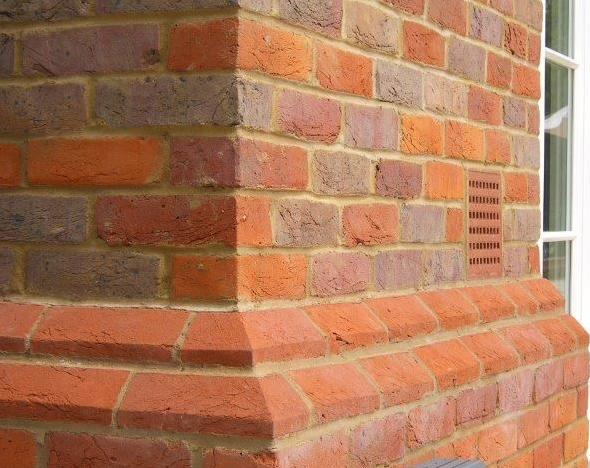
Eighties estate brickwork. A good deal of the housing here went up between 1983 and 2008, and houses of that period are cavity walls in machine made facing brick with a fairly thin, fairly weak joint. Thirty odd winters on the exposed elevation is enough to weather it back.
The tell is when the arris of every brick stands proud and the joint has gone sandy enough to scrape with a screwdriver. Raked out to roughly twice the joint width and repointed to the profile already there, normally a bucket handle, sometimes a weather struck one on the wall that takes the rain.
Integral garages and picture windows both mean a long concrete lintel with a course or two of brickwork sitting on it. When the lintel deflects, or the steel inside it corrodes and expands, the joints above crack in a straight horizontal line. The brickwork over comes out, the lintel and its bearing get checked, and it goes back. That needs the wall over it supported first, which is why it is a different job from pointing.
Estate frontages in Holton Heath are full of low walls, planters, bin store walls and gate piers, most built in a single skin off a shallow footing with no damp proof course. They wick water out of the ground, the base courses blow, and then the coping lifts and the run leans. This ground shrinks and swells, so where the rainwater ends up beside that footing matters. Rebuilt properly it goes on a foundation dug to firm ground, in stretcher bond with a dpc, piers where the run needs stiffening, and a coping bedded to throw water clear. Matching an eighties facing brick is genuinely hard, so we take a sample off the wall and source against it.
How it runs
Brickwork jobs on eighties houses, walls and garages
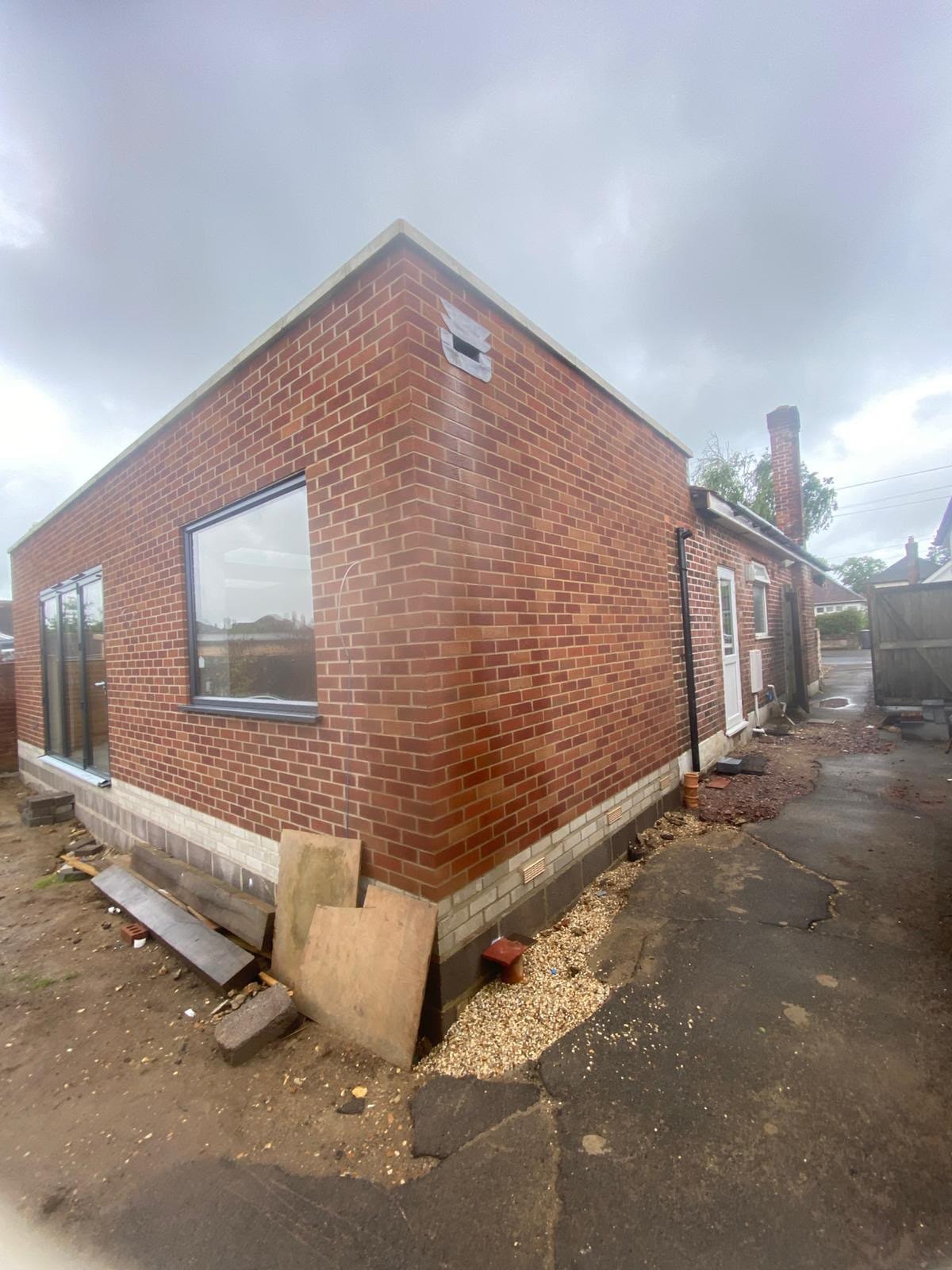
Thomas comes out, looks at the wall, and scratches a joint or two to see how the mortar is holding. Much of the brickwork at Holton Heath is from the post-war and 1980s building, laid in cement mortar with a garden wall or a garage alongside. The written quote breaks it down: access first, then raking out, the mortar mix, brick replacement, the area of each elevation, and disposal, each priced separately.
The work runs under one quote from start to finish. A bungalow wall is worked from a tower, a two storey gable from a scaffold. Windows and doors are sheeted before any raking starts, the dust is swept up each evening, and the rubble leaves with us. If a cracked lintel or a blown section shows up once we start, Thomas sends a photograph and a price and waits for your say before the work goes on.
Repointing in the same materials is repair, so there is nothing to apply for. Forming a new opening or removing anything load bearing is building control work, because the lintel and its bearings have to be signed off by Dorset Council. There is no conservation area here, and on the few listed buildings listed building consent comes first. On a wall shared with next door, the Party Wall etc. Act 1996 sets out the notice you must give.
Cost
Cracks, joints and platforms on a brickwork quote
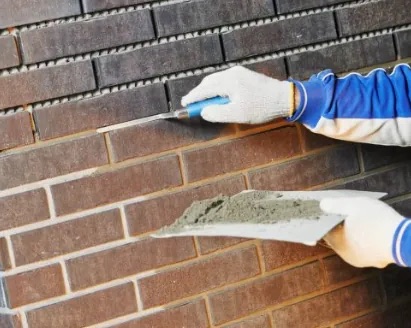
We do not work to a rate per square metre. Until you look at the joints, the size of the wall tells you very little.
Where the wall is. A detached house with an integral garage, a bungalow you can walk a tower around, and a low front wall on the pavement edge all set up differently. The platform is priced by how long it stands, and the work at height rules make it a line of its own.
Why it cracked. The ground in Holton Heath is cohesive and shrinks in a dry summer. A diagonal crack by a window or a stepped crack along the mortar can come from that, from a failed lintel, or from a downpipe dumping water beside the footing. Rebuilding without knowing which just brings the crack back, so finding the cause is part of the price.
Joints and faces. Hand raking is slow, and joint depth sets the hours. Spalled faces mean bricks cut out and replaced, and matching an eighties facing brick can take some finding.
Matching. Trial panels of mortar are mixed and left to dry so the colour sits with the old work.
Ask anyone else pricing it how deep the joints are raked and whether by hand or disc, what they think caused any crack, and whether the scaffold is included.
If something has moved
A wall that is leaning, cracked or dropping bricks
If brickwork is loose above a door or a front wall is leaning towards the pavement, keep people away from it and phone instead of filling in the form. The first visit is about making it safe: taking down loose bricks, propping where needed and fencing off what cannot be touched yet.
We then look at why it moved. A crack that has opened quickly after a dry spell or a very wet one is worth reporting, as on Holton Heath ground that can point to the footing rather than the wall. Our scheduled hours are Monday to Friday, 8am to 6pm. For anything that cannot wait, call, and if it rings out we will phone you back as soon as we can.
Worth knowing
How to tell a seasonal crack from one worth worrying about
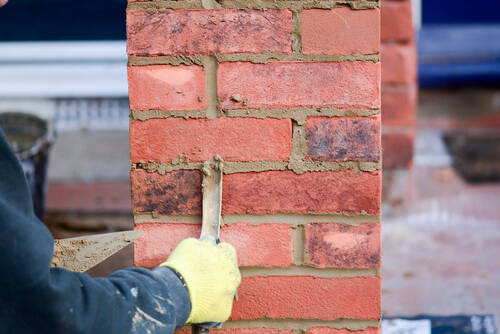
The ground under Holton Heath is cohesive, which means it shrinks as it dries through the summer and swells again over a wet winter. Foundations from the eighties are not deep, so the whole house rides that movement very slightly, and the brickwork shows it as cracking. Most cracks like this are exactly that.
The signs are consistent: the crack is fine, it steps down through the mortar joints rather than through the middle of bricks, it is usually near a corner or the reveal of an opening, it is wider at the top than the bottom, and it is at its worst at the end of a dry summer.
The useful thing you can do costs nothing. Mark each end of the crack in pencil, measure across it at the widest point, and look again after a wet winter. If it has closed up, it is seasonal, and it is worth raking out and pointing once, in a mortar deliberately weaker than the brick so the joint keeps taking the movement instead of the brick faces.
If it has kept opening, if it runs through bricks rather than around them, or if doors and windows have started binding on that side of the house, then you want a structural engineer to look before any bricklayer quotes you. We would rather tell you that and lose the job than point a crack that comes back.
Who you are dealing with
The bricklayer at your door is the owner
Boscombe, where our base is, lies 10.7 miles from Holton Heath. We also cover Sandford, Organford, Lytchett Minster, Upton and Wareham, across BH16 and BH20, all under Dorset Council. The business is Bournemouth Roofing & Building Ltd, registered in England and Wales, company number 15471719. Before you book a visit in Holton Heath, you can read our customers' Google reviews, word for word, on our reviews page.
Thomas Hannen runs it, and he looks at the wall and prices the work himself rather than sending someone else. There is a 10 out of 10 on Checkatrade from a verified customer. We make no charge for coming to see the brickwork or for the itemised quote in writing.
Planning at a glance
Do you need planning permission in Holton Heath?
Most repairs in Holton Heath need no application at all. What decides whether a change to the outside of your house does is who the council is, whether a conservation area or a listing applies, and whether the place sits in a protected landscape.
| Question | In Holton Heath |
|---|---|
| Who decides | Dorset Council is the planning authority for Holton Heath. Dorset Council's heritage pages set out what it controls. |
| Conservation area | None covers Holton Heath, so a like-for-like repair is ordinary maintenance. |
| Listed buildings | Yes, there are listed buildings in and around Holton Heath. If yours is one, work can need listed building consent. |
| Protected landscape | No National Park or National Landscape covers Holton Heath. |
Questions
Questions about bricklaying in Holton Heath
Our house went up in the 1980s. Can bricks be matched?
Usually, and more easily than on a Victorian wall. Much of Holton Heath dates from the 1980s onwards, and facing bricks of that period are mostly still made or have a close current equivalent. We lift a brick from a spot nobody sees, match it on size, texture and colour range instead of a single flat colour, and lay a small trial panel for you to look at both wet and dry before the main run goes in.
Do the Poole Harbour nutrient rules reach Holton Heath?
Only where the scheme creates a new unit. Holton Heath drains into the Poole Harbour catchment and those rules apply to a new dwelling or a separate unit of overnight accommodation, such as an annexe let on its own or a holiday let, not to your own house. Repointing, a new boundary wall and structural brick repairs stand outside it. If a new unit is part of the plan, settle it with Dorset Council before the bricklaying is booked, because it can change the scheme.
What causes the crack above our garage door?
Usually the lintel over the opening, not the building shifting. A garage head is wide, lightly loaded and often has a mild steel lintel with brickwork sat straight on it, so as that steel corrodes it lifts the courses above and the crack runs along the joint. On the naturally wet ground at Holton Heath we also check the fall away from the slab, because water standing at that corner speeds the whole thing up.
Is the tower or scaffold part of the written quote?
It is there as its own line so you can see it against the brickwork. There are plenty of bungalows in Holton Heath, and a single storey or low two storey elevation is within reach of a tower without a full scaffold. Where an elevation genuinely needs a platform we price that separately rather than folding it in. Thomas Hannen measures for access at the survey instead of adding it once work has started.
Which elevation would you do first on our bungalow?
The south west one: that is the exposed face at Holton Heath and it takes the driven rain, so its joints are always further gone than the rest of the building while the sheltered walls often have several winters left in them. Doing the weather side alone is proper repair, not half a job. The quote states plainly which elevations are priced and which are left out, so nothing is assumed on either side.
Nearby, and next door
Bricklaying near Holton Heath
Nearby places we also cover for bricklaying, with straight-line distances from Holton Heath, and the other trades we offer in Holton Heath itself.
Bricklaying nearby
Our other trades in Holton Heath
Brickwork and repointing guides
Lime or cement mortar: which do you need? Single storey extension: planning and building regs Subsidence cracks: which ones matterEverything we do in Wareham Bricklaying, all areas Every area we cover
Free quote
Get a price for your brickwork in Holton Heath
Tell us the address and where the crack or the bad pointing is. We will come out and put an itemised price in writing. Free site visit, no obligation.