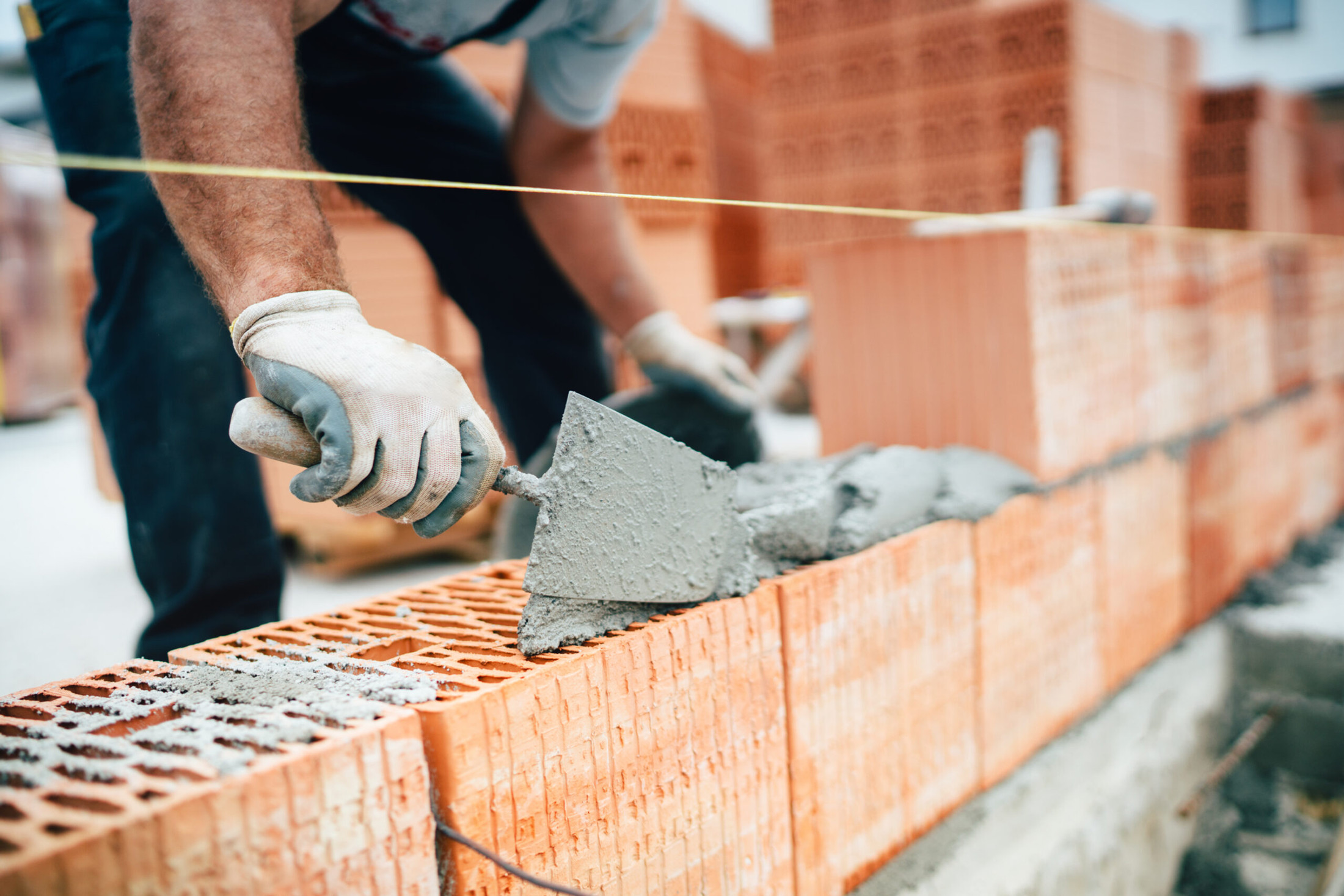
Ashley Heath repointing, all of it at eye level
On a bungalow every joint gets looked at from a yard away, so the mix, the match and the strike are the whole job.
The site visit is free and so is the written itemised quote. Thomas Hannen prices every job himself.
On a single storey house you can stand a foot away from the pointing and read every joint, so in Ashley Heath the finish is most of the job. The mix has to match, the strike has to be consistent along the whole run, and there is nowhere for a rough patch to hide.
What brings people to the phone is usually something noticed while doing something else. Cleaning the gutters and seeing sand in them. Weeding a border and finding the joints beside the downpipe have gone back a finger's depth. A flaky brick face under a window that gets worse each spring. Or a repair somebody did years ago that has stayed a different colour ever since.
All of that is mortar rather than structure, and none of it means the wall is failing. We walk every elevation, scrape a few joints on each to see how deep the decay has gone, tap the courses for the hollow note that means the pointing has lost its grip, and photograph what we find. Back it comes in writing, itemised and split by elevation, with the faces we would leave alone said plainly. The survey and the quote are free.
The work
Mortar repairs on a modern Ashley Heath house
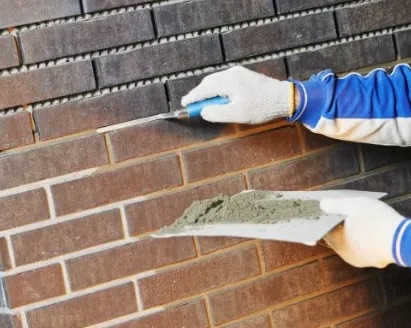
Cavity brickwork from the seventies and eighties. Half the houses here went up between 1945 and 1982 and another quarter after that, so almost everything is cavity work: a single outer skin of fired brick in a cement and sand mortar, struck weather or bucket handle. Mortar of that age rarely washes out the way a soft old joint does. It pits and opens at the arris, water stands in the hollow, and the first proper frost lifts flakes off the brick either side. Matching it means matching the sand and the gauge as well as the colour, so a trial panel goes up on a discreet elevation for you to see in daylight.
Raking out, and why not with a grinder. Joints come out to about twice their width, the perpends by hand. A disc cutter is quick on a long straight bed joint and it is also how a wall gets its arrises taken off, which is why plenty of cheap repointing looks worse after a year than what it replaced. Joints are damped down before filling so the mix cures rather than flashing off, then brushed back once it has taken up.
Spalled faces. Where a face has blown we cut the brick out whole and turn or replace it against a sample held on the wall, rather than filling the hollow with mortar that never matches and drops out within a couple of winters. On this stock the damage collects under sills, beside downpipes and in the courses just above the damp proof course where a drive has been laid hard against the house.
Chimneys and the odd bit at height. Not every bungalow here has a stack, but where there is one it is the oldest and coldest masonry on the building, with weather on four sides and nothing warming it. Its joints go friable long before anything at ground level, and the penetrating damp that follows shows on a ceiling. That wants a scaffold. Almost everything else on a single storey elevation is reachable from a tower.
Porch, garage and low front walls. The brickwork around a porch, either side of a garage opening or along the front of a plot has no shelter and often a coping that has stopped doing its job. Water gets into the top, freezes and works the joints apart from inside. Repointing the coping and the exposed face is short work.
The little that is genuinely old. Only a small share of the houses here predate 1919, but where a property is solid wall rather than cavity the answer changes: an NHL lime or lime putty mix matched to the original sand, so the wall can still lose water through the joint. A hard modern mix on a soft old wall is the fastest way to lose the brick faces.
How it runs
From your call to a written price
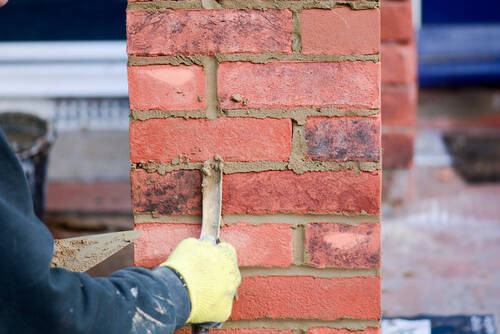
Same team from first visit to last, one person to ring, and no sub-contracting your work out. The quote is itemised: access, raking out, the mortar mix, the area of each elevation, brick replacement and disposal on separate lines.
Nothing is left open overnight. The site is swept at the end of each day, and what comes out leaves with us. If something turns up that nobody could have seen, you get a photograph and a price before we carry on.
Repointing like for like is repair rather than development, so there is nothing to apply for and nothing for building control to sign off. Ashley Heath has no conservation area and a single listed entry, so on almost every address here the mortar and the joint profile are a technical choice rather than a planning one. Where a property is the listed one, mortar counts as protected fabric and listed building consent from Dorset Council is needed first.
Cost
What decides the price of a repointing job
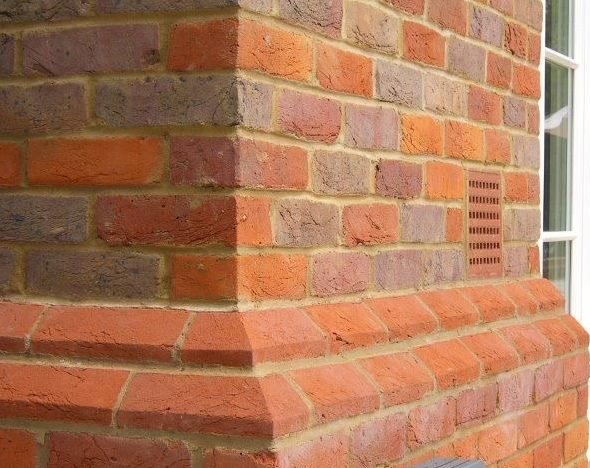
No rate per square metre: the area tells you almost nothing until somebody has looked at what the joints are actually like.
Getting to it. A detached bungalow with a long weather side, a chalet with a dormer gable and a low wall across the front of a plot are three different set ups, and only one needs a proper platform. A chimney or a gable wants a scaffold, and how long the platform stands matters as much as how big it is. Access under the work at height rules is a priced line, not absorbed into a rate.
The joints decide it, not the wall. How deep the joints have to come back, and whether the faces have already spalled, sets the hours far more than the area does. Hand raking is slow, but a disc widens the joint and takes the arris off.
Matching is the part that shows. Too strong a mix holds water against a soft brick and the face blows off in the first hard frost. Lime is the right answer on most pre-1919 walls here.
Comparing quotes? Ask how deep the joints are raked and by hand or disc, what the mix is and whether it was matched, how many spalled bricks are being replaced, and whether the scaffold is in the price.
If water is getting in
Open joints, and water coming through the wall
Ring rather than use the form. Joints washed out let driven rain straight through to the inside face, and on a chimney it finds the flashings as well. We come and look, sheet the worst if the weather is against us, and price the elevation once it has dried enough to see what is sound. Round here it is usually the south west facing elevation, or a strip of wall under a gutter that has been overflowing for a couple of winters. The phone is answered 24 hours for emergencies; scheduled work runs Monday to Friday, 8am to 6pm.
Worth knowing
Every joint on a bungalow is at eye level
More than half the homes in Ashley Heath are bungalows, and that changes a repointing job in a way people do not expect. On a two storey house nobody looks closely at the pointing above the ground floor windows, so a slight difference in colour is invisible from the pavement. On a single storey elevation the whole run of wall sits between waist and shoulder height. Every metre of it gets looked at, from a foot away.
So on this stock the matching and the strike are not finishing touches, they are the work. We mix in consistent batches rather than making up a fresh gauge whenever we run out, keep one person striking a given elevation so the profile does not drift, and finish at a corner or an opening rather than stopping halfway along a wall. It also means we would rather do a whole elevation than a patch.
Who you are dealing with
A local firm you can check
We cover Ashley Heath, St Leonards, St Ives and across to Ringwood and Verwood, broadly BH24, under Dorset Council. You are dealing with Bournemouth Roofing & Building, the trading name of Bournemouth Roofing & Building Ltd, registered in England and Wales, company number 15471719, which you can look up in a minute. Thomas Hannen's business, and he is the one who comes out to price the job, not a salesman. A verified customer's 10 out of 10 on Checkatrade. The visit and the written quote are both free.
Questions
Ashley Heath questions we get asked
An old repair on our wall is still a different colour. Can that be sorted?
Usually, yes. A patch shows either because the sand was wrong or because the joint was struck to a different profile, and both are fixable by taking that mortar out and putting a matched mix back. We make up a trial panel first and let you look at it in daylight, because fresh mortar reads lighter than weathered mortar.
Do you need a scaffold to repoint a bungalow?
For the walls, generally not. Most of a single storey elevation is workable from a tower or trestles, which takes the biggest single line out of the quote. A chimney is the exception, because repointing a stack means standing there for hours with both hands busy. Where a scaffold is needed it appears as its own line.
What joint profile goes back on a seventies house?
Whatever the wall already carries, which on this stock is almost always bucket handle or weather struck. Both shed water off the joint rather than letting it stand on a flat shelf of mortar. We do not change a profile on a visible elevation without agreeing it with you first, because it alters how the whole wall reads.
Is there any lime pointing to be done in Ashley Heath?
Some, but not much. Only a small fraction of the housing here is old enough to be solid wall, and those are the ones that need lime. If your walls are cavity, which almost all are, the right answer is a cement and sand mortar gauged a little softer than the brick and matched to the original sand.
How long would the outside of a bungalow take to repoint?
Days rather than weeks for a single elevation, and longer for the whole building, because hand raking is the slow part and there is more wall on a bungalow than people expect. The quote gives you working days per elevation and says what would push it, which is nearly always the weather.
Nearby, and next door
Repointing near Ashley Heath
Repointing nearby
Our other trades in Ashley Heath
Everything we do in West Moors Repointing, all areas Every area we cover
Free quote
Ask for a trial panel before you agree the work
Thomas walks each elevation, tests the joints, photographs the wall and sends a written itemised quote with the access shown separately. Free.