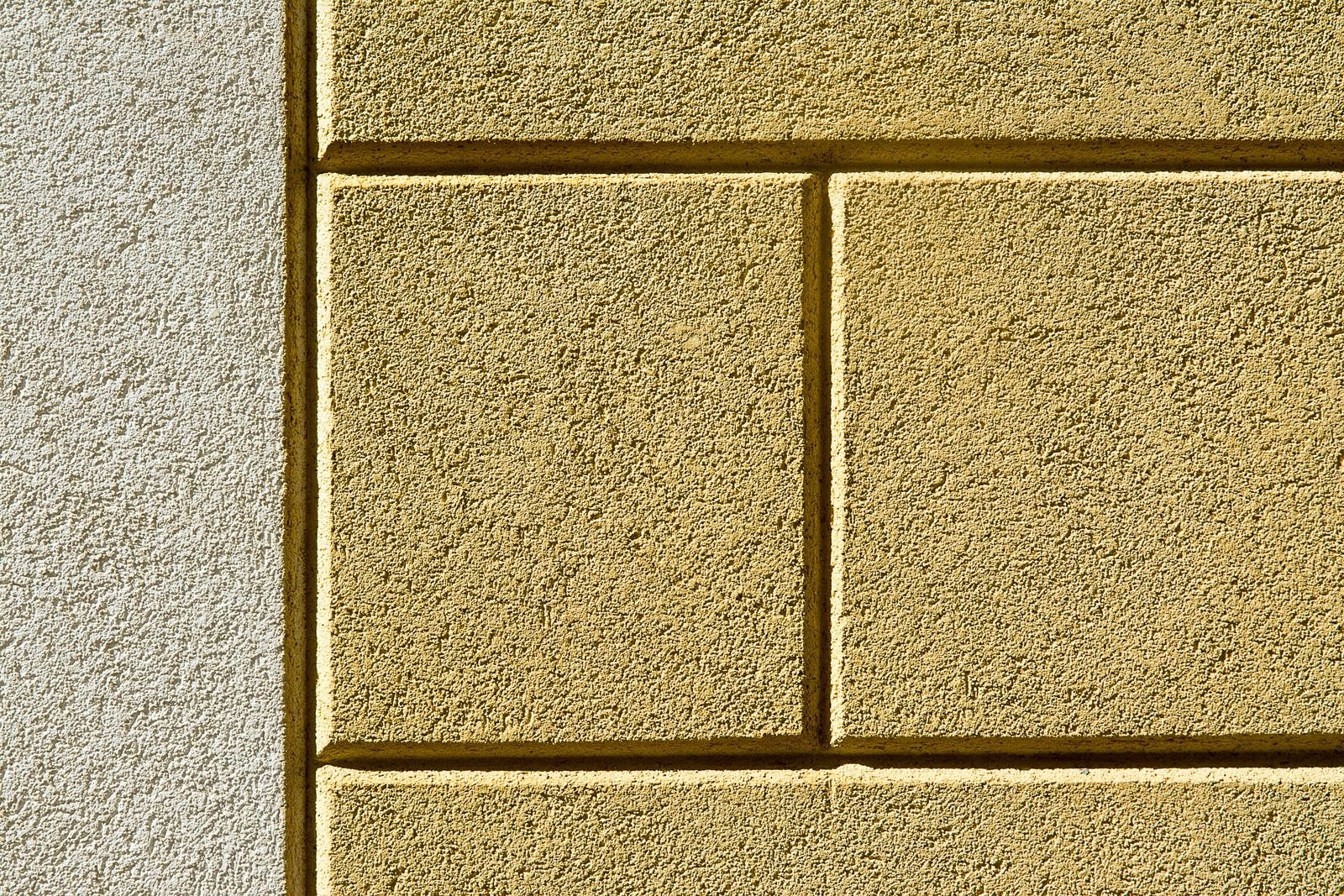
Rendering in Sandford
Most of this village went up in one stretch, so when a rendered detail fails it tends to fail along the whole street rather than on one house.
The site visit is free and so is the written itemised quote. Thomas Hannen prices every job himself.
Sandford is a post-war village and most of it was built inside about twenty five years. The render came from the same few specifications, went on at the same time and is now the same age, which is why one house having trouble usually means the neighbours are next.
The calls are fairly consistent. A dashed panel shedding its aggregate. A gable that drums when you knock it. A crack from a window head that has been filled twice and come back both times.
Half the houses here are semis or terraces, which changes the job as much as the render does, because a render has to stop somewhere and a party line is usually the only honest place. We tap the elevation, work out where it stops, and write it up itemised for nothing.
The work
Dashed panels, drumming gables and where a render stops
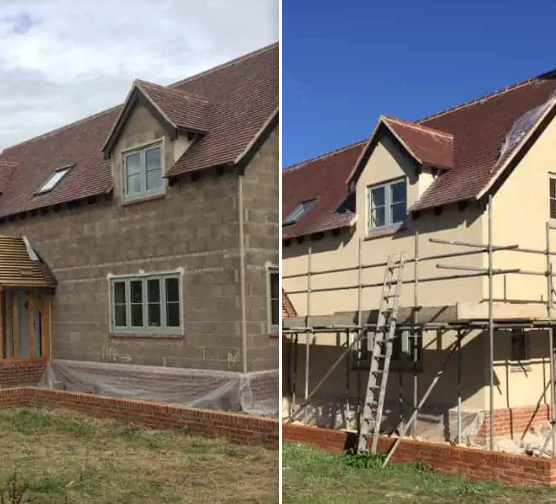
Sounding the wall. Every quote starts with tapping. Sound render answers dead, blown render drums, and on these houses the hollow area usually runs from the crack out to the nearest opening. What we chalk is what goes on the quote.
Hacking off and preparing. Render that has parted from the background comes off to the block, the wall is cleaned down, anything friable is stabilised and the background left to dry. A basecoat over a hollow area is money thrown away.
Silicone thin coat. A polymer basecoat with mesh right through it, a primer, and a through-coloured silicone topcoat scraped to a texture. It flexes with a lightweight block wall, which is what most of the village is built of, and there is no paint film to fail.
Monocouche. A single through-coloured material in two passes, scraped back the next day. It gives a clean, even face and it wants a good background, so we say honestly when a wall has been patched too often to suit it.
Traditional sand and cement. A scratch coat and a float coat ruled off, then a breathable masonry paint. Much of the original render here is exactly this and a good deal of it is still sound.
Pebbledash and Tyrolean. Dashing throws aggregate into a wet coat, Tyrolean is flicked on by machine, and both are all over the late 1960s and early 1970s stock in this village. Both repair well, and the texture is matched from a sample panel before we start.
Beads, bellcast and stop ends. A bellcast bead at the foot throws water clear of the wall below. Stop beads give a clean edge at a soffit or a party line, angle beads keep a reveal straight, and a movement bead lets a long elevation move without splitting.
Cracking, delamination and algae. Map crazing is a surface fault and can be bridged with mesh and recoated. A crack from an opening is movement, and covering it changes nothing. Frost turns either into a blown panel. Green growth is treated and cleaned down at low pressure.
Render over external wall insulation. On an EWI job the render is the weather face of the system, over a render carrier board or the boards themselves, with a mesh basecoat and a thin coat over it, and every bead, sill and pipe reset to the new thickness. It is worth pricing while the access is already up rather than as a separate job later.
Older, solid walls. A few pre-1919 buildings sit among the newer stock. Those are solid, they dry through their own face, and they want a breathable lime render rather than a modern system that leaves moisture trapped.
How it runs
From your call to a written price
Same team from first visit to last, one person to ring, and no sub-contracting your work out to somebody you have never met. The quote is itemised, not a figure on the back of a card: access and scaffold, protection, preparation of the existing wall, the system and number of coats, beads and stop ends, and making good on separate lines, so you can compare it properly against anyone else's.
Nothing is left open or unusable overnight. The site is swept at the end of each day rather than the end of the job, and what comes out leaves with us. If something turns up once we start that nobody could have seen, you get a photograph and a price before we carry on.
There is no conservation area over Sandford and only a handful of listed entries in the parish, so on an ordinary house putting a similar finish back on a wall that is already rendered is repair rather than development, and Planning Portal guidance on external walls sets out where that line falls. If a building is listed then a change of render needs listed building consent however plain it looks. Renewing a whole elevation is the point at which Approved Document L asks whether the wall should be insulated while the access is there, and building control comes in on an upgrade. Dorset Council handles it.
Cost
What decides the price of a rendering job
No rate per square metre, because the square metres are the easy part; what is already on the wall decides the price.
Getting to it. A semi with a shared gable, a terrace end wall and a detached bungalow on the newer part of the village are three different platforms. A bungalow gable comes off a tower, a three storey elevation wants a scaffold, and the platform has to stand for the whole system rather than a day. The work at height rules are why it is a priced line rather than something folded into a rate.
What is already on the wall. Rendering over sound brick is one job. Hacking off blown sand and cement, or a pebbledash that has parted from the background, is another, and it is the part nobody can see from the road. We tap the whole elevation before quoting, because the hollow areas set the hours.
The system, and what the wall behind it needs. Silicone thin coat over insulation, monocouche through-coloured, or traditional sand and cement all price differently and behave differently. On a solid wall that has to breathe, a plastic-rich modern system traps moisture and moves the problem inside, so the right system is a wall decision rather than a colour decision.
Comparing quotes? Ask which system is being quoted and how many coats, whether the old render is being hacked off or overlaid, whether beads, bellcast and stop ends are included, whether the scaffold is in the price, and what happens to the existing sills and pipework. Two quotes for the same job are usually two different jobs.
If it has started to come away
Render that has blown or cracked open
Ring rather than use the form. A section that sounds hollow when you tap it, or a crack you can get a coin into, is letting water behind the render and the frost does the rest. We make the loose area safe, sheet it if the weather is against us, and price the elevation once we can see how far the blown area actually goes. On a semi or a terrace, tell your neighbour early, because loose render above a shared path is their problem as well as yours. The phone is answered 24 hours for emergencies; scheduled work runs Monday to Friday, 8am to 6pm.
Worth knowing
On a semi, the render stops at the party line
Around half the houses in Sandford are semi-detached or terraced, and that changes a rendering job in a way people do not expect. Render is a continuous skin. It has to be stopped on a bead, a corner or an opening, because anywhere else the joint shows as a line and casts a shadow in low sun. On a pair of semis the only honest stopping point is the party line, which means your half will be new and next door's will be whatever it is now, and the difference shows from the pavement.
So it is worth a conversation before you commit. Two neighbours doing a front elevation together share one scaffold, one set-up and one delivery, and the finish runs across both without a visible break. If that is not possible we design the stop in rather than pretend it is not there: a stop bead on the party line, a texture matched off a sample panel, and a colour chosen in daylight next to the existing wall. That is a decision for before the quote, not after the scaffold is up.
Who you are dealing with
A local firm you can check
We cover Sandford, Holton Heath, Wareham, Stoborough and Organford, broadly BH20, under Dorset Council. You are dealing with Bournemouth Roofing & Building, the trading name of Bournemouth Roofing & Building Ltd, registered in England and Wales, company number 15471719, which you can look up in a minute. Thomas Hannen's business, and he is the one who comes out to price the job, not a salesman. A verified customer's 10 out of 10 on Checkatrade. The visit and the written quote are both free.
Questions
Sandford questions we get asked
Our neighbour's render looks the same as ours. Is that a coincidence?
No. Most of this village went up inside about twenty five years and the builders used the same detail plot after plot. Same background, same specification, same age. If one house is drumming along the bottom of a gable, there is a fair chance the row is doing the same thing quietly.
Can we render our half of a semi?
Yes, and plenty of people do. The thing to decide first is where it stops. We finish on a stop bead at the party line so the edge is deliberate rather than ragged, and match the texture from a sample panel. It will still read as two halves for a while, which is worth knowing before you order it.
Can pebbledash be repaired or does it all come off?
It repairs well if the background is sound. We put a sample panel up, match the aggregate and the throw, and let you see it on your own wall in daylight before the elevation is done. Where the dash has parted from the wall behind it, that area comes off first.
What is the mesh in the basecoat for?
It holds the basecoat together as the wall moves, so a hairline movement in the block does not turn into a crack through the finish. It runs across the whole elevation with extra diagonal pieces at window and door corners, which is where cracks start.
Do you take the old render away?
Yes. Hacked-off render is heavy and there is a lot of it, and it leaves with us rather than sitting in your drive. The disposal is a line on the quote so you can see what it costs rather than finding it folded into a rate.
Nearby, and next door
Rendering near Sandford
Rendering nearby
Our other trades in Sandford
Everything we do in Wareham Rendering, all areas Every area we cover
Free quote
Get the elevation tapped and the stops planned
Thomas comes out, sounds the wall, works out where the render should stop and itemises the lot in writing. The visit and the quote are free.