Insulation in Everton
Loft insulation, cavity wall fill and warm roofs across Everton and the SO41 villages between Lymington and New Milton. The visit and the written quote are both free.
The site visit is free and so is the written itemised quote. Thomas Hannen prices every job himself.
Last updated
On an Everton bungalow the loft is the ceiling of the whole house, so what you do up there matters more than it would on a two-storey place. The catch is the edges. A low hipped roof runs out of height at the eaves long before the insulation runs out, and that is where most of the heat you are paying for actually leaves.
An Everton house short of insulation is cold at the outside walls, shows its joists through the ceiling paint, or has a loft done once long ago. A room that is fine in the middle and cold the moment you sit near an outside wall. A ceiling that shows faint lines through the paint in winter, which is the joists telling you the top layer was never run across them. Or a house bought in the last year where the loft was clearly done once, a long time ago, and never touched since.
We get into the roof space and into the rooms below it before anybody says a number. Half the answer is always the same, which is depth. The other half is what the roof is doing at the perimeter, how the eaves are ventilated, and whether the walls have anything in them. You get it back in writing, itemised, and you decide which parts to do and in what order. If the honest answer is that the loft alone will fix it, that is what the quote will say.
The work
Insulating a bungalow whose roof space is the only storage
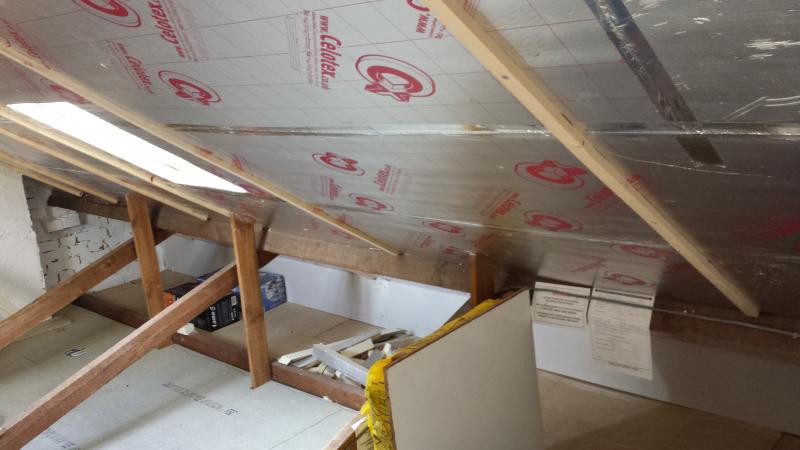
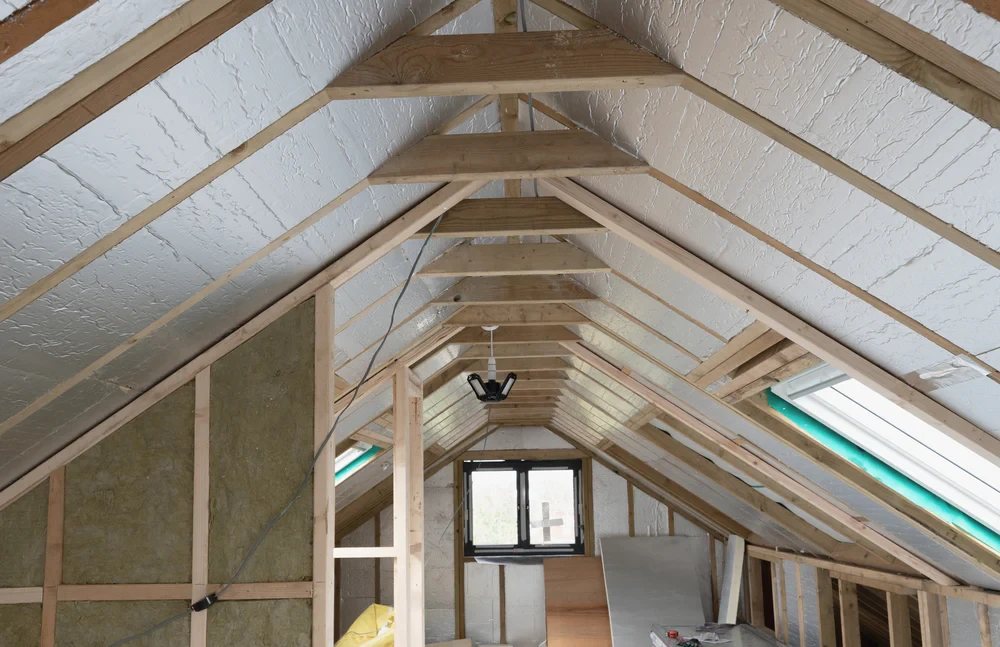
Loft insulation in a low, hipped roof. Bungalows make up a large part of the housing along this stretch, and most of them went up in the late fifties and early sixties, under shallow roofs with hips at both ends and very little height where the rafters meet the wall plate.
Across the middle it is a straightforward day. At the hips, and in the last half metre all the way round, it is on your knees working material down to the wall plate without blocking the airflow, and that perimeter is the difference between a loft that performs and one that reads well on paper. We lay mineral wool between the joists and a second layer over and across them so no timber is left bare.
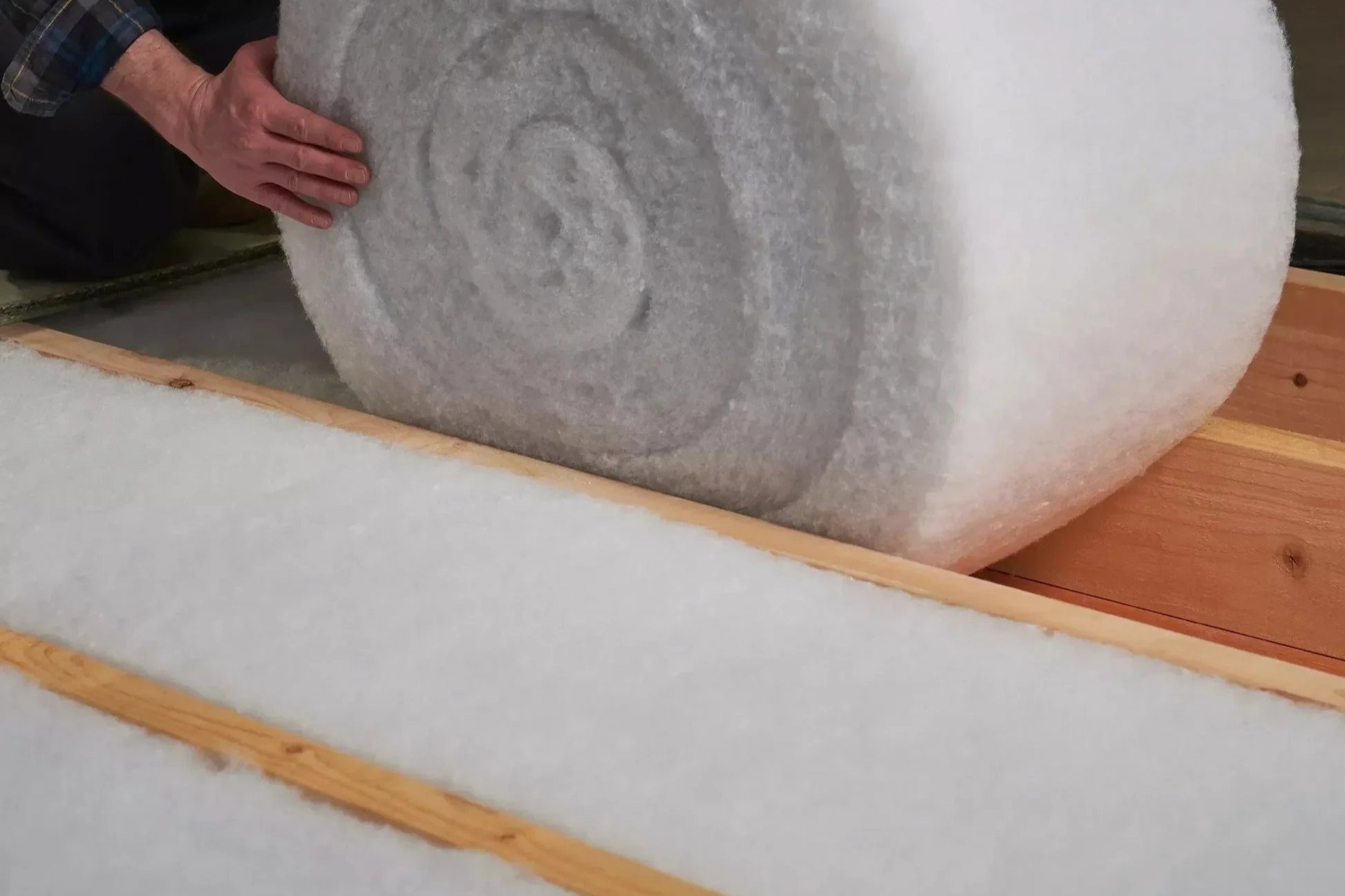
Depth, and the only number worth arguing about. Approved Document L puts a renovated loft at a u-value of around 0.16, which is 270mm in ordinary mineral wool or nearer 250mm in a denser product. Old material that has settled, compressed or gone damp comes out first and leaves with us, never buried under the new.
A bungalow loft is often the only storage in the house, which is exactly why so many of them have boards laid straight onto the joists with the insulation squashed flat underneath. The boarding goes back on raised legs above the full depth, with the roll running on underneath it. Where a loft has been converted or a dormer added, the insulation belongs at rafter level: PIR rigid board between and under the rafters, or a foil faced quilt where the headroom will not take board, with a vapour control layer on the warm side and a clear air gap above.
The later houses on the edges of the village usually have something in the cavity already, and drilling into a wall that is already full wastes your money, so we check with a borescope first. Under three kilometres from the water, the seaward elevation is the one that stays damp between showers, and that is the wall where a bridged or slumped fill shows itself inside. Then vent trays at the eaves, covers over the downlighters, lagging on the tank and every pipe now above the insulation, and a hatch that is insulated and draught sealed rather than left as a hole in the ceiling, which on a bungalow sits in the hall right where the warm air collects.
How it runs
Insulating a bungalow ceiling or wall, survey first
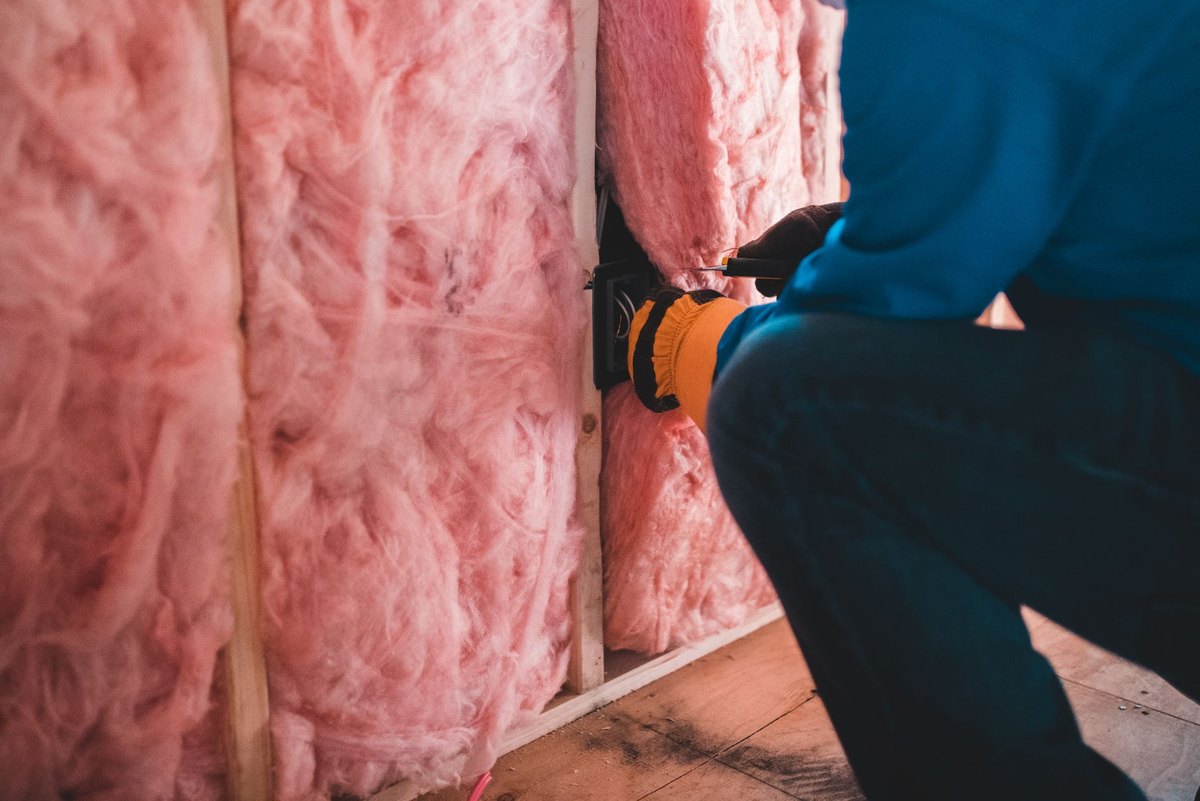
Thomas comes out and does the survey himself. He goes up through the hatch, measures what is there now, looks at the ventilation at the eaves, and checks the walls to see whether they have a cavity. The written quote shows the survey, clearing out old material, what is going down and to what depth, any ventilation works, and disposal, each priced. The work then follows that quote line by line.
A bungalow loft is large and low, and in Everton it often has a hatch in the hall ceiling. We sheet the hall and the route in, lay mineral wool in two layers between and across the joists, keep the eaves clear for air, and lag pipes and tanks that end up in the cold. Old material is bagged and taken away, and nothing is left open or unusable overnight. If we find damp timber, a hole in the underlay or wiring that should not be buried, Thomas photographs it and prices the fix, and you decide.
Loft and cavity work is permitted development and needs no application, as Planning Portal guidance on insulation sets out. Everton is in New Forest District, outside the National Park, and if you are unsure which side of the Park boundary you are on, the National Park Authority's interactive property map will show you. Only external work would turn on that, and there is no conservation area over the village.
Cost
Hatch, storage and depth: what insulation costs turn on
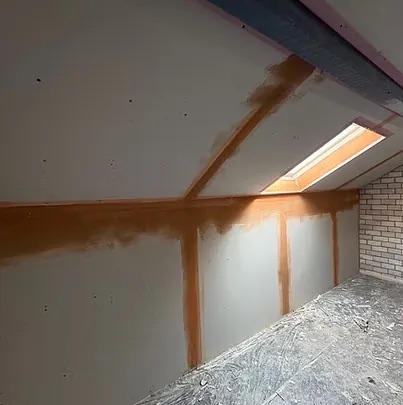
Insulation is priced on the house, not by the square metre. A big roof over a small floor. Everton is largely bungalows, and a bungalow's loft is as big as its whole footprint. There is more to cover, and more to gain, because so much of the heat leaves through the ceiling.
Getting started. An empty loft over a hall hatch is straightforward. Boarding covered in stored boxes adds hours, and a chalet with rooms in the roof and a dormer needs its sloping ceilings and knee walls treated instead. Any old material has to be bagged and removed, and belongings shifted and returned, before the new goes down.
Air. The eaves have to stay open. Older roofs with bitumen felt underlay may need extra vents so moist air can get out, and that is a line of its own.
Walls. Post-war houses usually have a cavity. A borescope shows whether it is empty, already filled or blocked with mortar droppings.
Approved Document L sets the level the work must reach. Ask any other installer how deep, is the old material coming out, and are the loft hatch and pipes in the price.
If it is urgent
Condensation, or a room that stays cold
A phone call suits this better than the form. Condensation dripping in the loft, mould that returns however often you clean it, or a room that stays cold with the heating on all need looking at.
If a bedroom on the side facing the sea has mould along the top of the outside wall, that corner is usually a cold bridge where the loft insulation stops short. Air the room each day and keep furniture off that wall. On the first visit we look in the loft and check the eaves and the ventilation. Insulation jobs are booked Monday to Friday, 8am to 6pm, and a missed call gets a ring back as soon as we can.
The one local thing
Two and a half kilometres from the sea, and what the wind does
Everton sits 2.6km from the coast with its most exposed elevation facing south west, straight into the prevailing weather off the Solent. On a two-storey house that mostly shows up as driven rain on one wall. On a bungalow, where the eaves run round the entire building at head height and the roof is shallow, it shows up inside the loft.
Wind gets in under the tiles and at the eaves and moves across the surface of the insulation, lifting and scouring the edge of the roll and carrying warm air out with it. The trade calls it wind washing, and it is why a loft can measure a full 270mm in the middle and still leave a cold ring round every room below it.
What that changes is where the care goes, not what gets bought. The roll needs tucking down firmly to the wall plate rather than stopping short, but never so far that it blocks the eaves gap, so vent trays go in first and hold the air path open behind it. On an exposed perimeter we will often use a rigid board at the edge, where mineral wool would be lifted, and keep the wool for the open middle.
Salt air is the second half of it: it keeps everything damp for longer between showers and it eats at metal fixings from the edge inwards, so the loft is the wrong place to run bare pipework and the right place to be generous with lagging. If a quote for a seaward bungalow talks only about square metres and depth, it has not been up there and looked at the eaves.
Who you are dealing with
Insulation across SO41 from a named local company
We insulate lofts and walls in Everton and the SO41 villages between Lymington and New Milton, including Hordle, Milford on Sea and Barton. Everton is 10.8 miles from Boscombe, where our base is, and it falls under New Forest District Council.
The company is Bournemouth Roofing & Building Ltd, registered in England and Wales, company number 15471719. It is Thomas Hannen's business, and he goes into your loft and prices the job himself. A verified customer has given us a 10 out of 10 rating on Checkatrade. Both the survey visit and the written quote, with every line itemised, are free. Before you book a visit in Everton, you can read our customers' Google reviews, word for word, on our reviews page.
Planning at a glance
Do you need planning permission in Everton?
Most repairs in Everton need no application at all. What decides whether a change to the outside of your house does is who the council is, whether a conservation area or a listing applies, and whether the place sits in a protected landscape.
| Question | In Everton |
|---|---|
| Who decides | New Forest District Council is the planning authority for Everton. The National Park boundary runs close by, and the Park's property map shows which side an address falls. |
| Conservation area | None covers Everton, so a like-for-like repair is ordinary maintenance. |
| Listed buildings | Yes, there are listed buildings in and around Everton. If yours is one, work can need listed building consent. |
| Protected landscape | No National Park or National Landscape covers Everton. |
Questions
Questions about insulation in Everton
We are close to the Solent. Does salt reach the loft?
Yes, salt reaches the fixings in the loft, not the quilt. Everton sits under three kilometres from the coast, and salt in the air corrodes nails, clips and steel straps from the edge inwards while keeping surfaces damp between showers. That matters when we lift tiles at the verge to fit vents, because a corroded fixing snaps, not comes out. We allow for replacing them rather than finding out on the day.
Everton has a lot of bungalows. Is the whole ceiling done?
All of it, and in a bungalow that is every ceiling in the house. Bungalows are common in Everton, and in one there is no upstairs acting as a buffer and the cold surface runs from the front wall to the back. It also means we are working over bedrooms, a bathroom and a kitchen in one go, and the kitchen and bathroom ceilings are where the moisture comes through.
Are we in the National Park for planning purposes?
Your planning authority in Everton is New Forest District, not the National Park authority, which is a distinction that matters a few miles up the road. There is no conservation area covering Everton either, so a loft job, a rooflight or a change of covering is ordinary work for almost everybody. Fifteen listed entries exist in the settlement, Efford House among them, and those are the exception we check for.
Why does the seaward wall feel damp inside in winter?
Driven rain on the exposed face, which in Everton is the south west elevation. Water crosses a cavity on a mortar snot or a badly fitted tie, or soaks straight through solid work, and a wet wall reads as cold to the touch and conducts heat out. Filling that cavity with insulation before the water path is fixed makes it worse. We deal with the wall first.
Our bungalow is from about 1960. What is in there now?
Typically a thin layer laid decades after the house went up, sitting between shallow joists. The peak building period in Everton was the late 1950s and early 1960s, and ceiling joists from that era are far shallower than the depth of insulation now expected. The answer is a second layer run across the joists rather than trying to cram everything between them, which also covers the timber itself.
Nearby, and next door
Insulation near Everton
Nearby places we also cover for insulation, with straight-line distances from Everton, and the other trades we offer in Everton itself.
Insulation nearby
Our other trades in Everton
Insulation guides
Part L: do you have to insulate when you re-roof? Black mould on walls: what causes it and what stops it PIR board vs mineral wool: which insulation?Everything we do in Lymington Insulation, all areas Every area we cover
Free quote
Get the eaves looked at, not just the middle
A free survey in the roof space, then an itemised written price with the perimeter, the depth and the ventilation each on their own line.