
Driveways and patios in East Boldre
Gravel, resin bound, tarmac, concrete standings and stone patios across East Boldre and the Forest lanes. Free site visit, free written itemised quote.
The site visit is free and so is the written itemised quote. Thomas Hannen prices every job himself.
Out at East Boldre the drive is usually a long one, and long drives fail in the middle rather than at the house. Ruts, soft spots and standing water mean the stone has been pushed down into the ground underneath it, and no amount of fresh gravel on top will hold once that has happened.
The calls from East Boldre are rarely about the look of the thing. An entrance that has turned to a trench after a wet fortnight. A gravel drive that keeps ending up out on the verge, so the postman drives over grass and you are forever raking stone back in. A yard or a standing that has gone soft where a trailer sits. And, at the back of the house, a patio that has dropped towards the wall and now holds a puddle by the door.
All four have the same root, which is what is under the surface rather than the surface itself. The free site visit is a spade and a look: we open a hole at the worst point, see how deep the stone goes and what it is sitting on, and tell you whether the answer is a re-lay, a new sub-base, or a bound top over a base that is sound already. You get that in writing before anybody starts.
The work
Long drives, gateways and yards around East Boldre
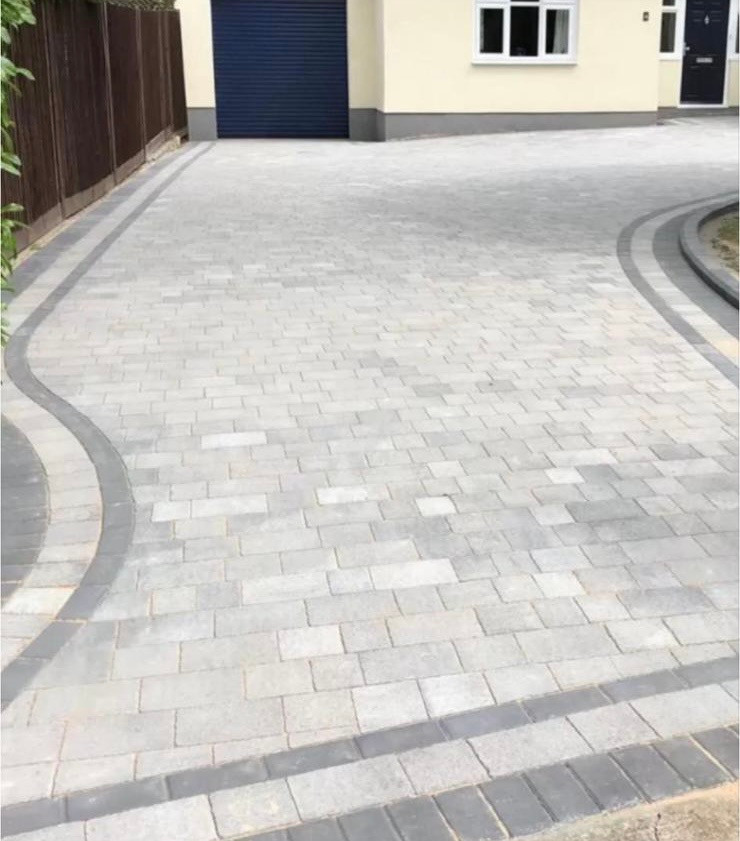
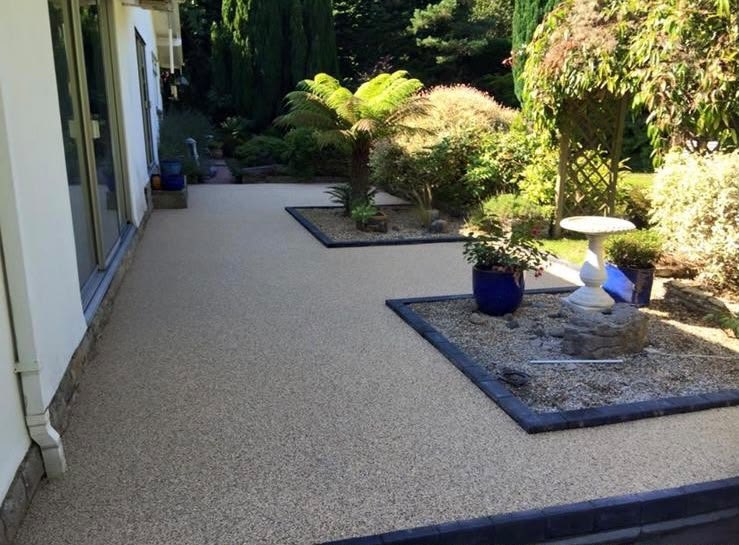
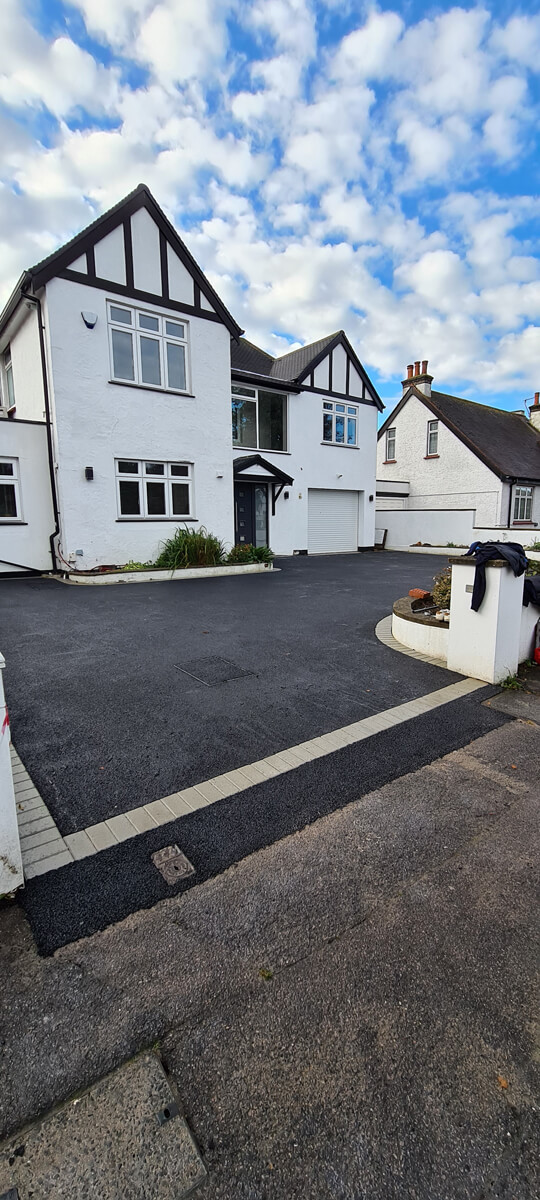
The entrance, first. On a plot with a field gate the first few metres take every wheel that ever comes in, and that is where the potholes are. We dig out the soft ground, lay a geotextile membrane so the stone and the subsoil stop mixing, then build a sub-base in layers and compact each one. Depth comes from what the ground is doing and what drives over it, because a horsebox and a hatchback are not the same load. A bound apron of tarmac or resin over that last bit stops loose stone being dragged out onto the verge every time you leave.
Loose stone works out here, and it fails when it is tipped straight onto grass. Done right it is an excavation, a membrane, a compacted base, an edge restraint haunched in concrete along both sides, and only then the top course, kept shallow enough to walk on and drive on rather than wade through. Where a drive falls towards the road we build a camber and take the water off sideways rather than letting it run to one point and wash the surface with it.
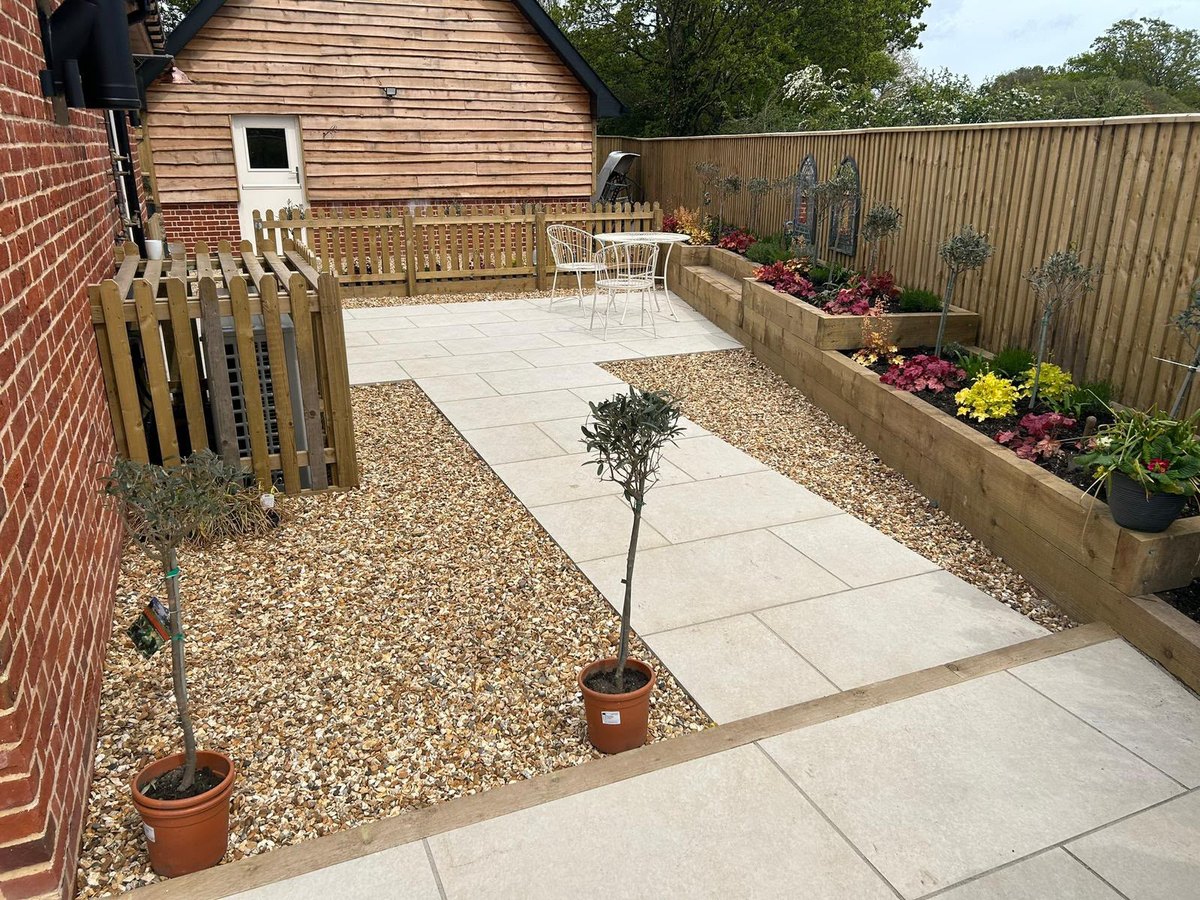
Where the water goes. There is no surface water sewer to run into here, so it stays on the plot: a permeable build, a soakaway sized from a percolation test rather than a guess, or a positive outfall to a ditch where one is yours to use. Approved Document H sets the order those should be considered in, and a drive that ponds or is staining green is almost always this rather than the surface. Patios and steps go on a full mortar bed with a fall away from the wall and the finished level set clear of the damp proof course and the threshold. Where there is block paving, the jointing matters as much as the blocks: kiln dried sand washes out of an open joint, weed gets into it, and a re-sand with a sound edge is what stops a wheel track going sunken.
How it runs
From your call to a written price
The quote is itemised, with excavation, muck away, the sub base, edgings, the surface and the drainage all on separate lines. Paving round a house is normally permitted development, with the front garden rule as the catch: more than five square metres of impermeable surface at the front needs planning permission unless it drains to somewhere on your own land that can take it, which the rules on paving a front garden explains. East Boldre sits inside the New Forest National Park, so the National Park Authority is the planning route here, and the village is in the Forest South East conservation area, which means the look of a frontage is not entirely your own decision.
Cost
What decides the price of a driveway
We do not price by the square metre, because what is under the surface decides more of the cost than what goes on top. A smallholding with a field gate a tipper can come through, a pair of cottages on a narrow frontage where the lorry has to stand on the road, and a bungalow behind a hedge with a soft verge in front of it are three different jobs before a spade goes in. Out here the ground under it and where the water goes are the real variables. Ask what depth, what sub base, and who takes the spoil.
If it is urgent
A trip hazard, or a drive that floods
Ring rather than use the form. A slab that has lifted or cracked, or a gully that has stopped taking water will not wait. Around East Boldre it is more often a gateway churned into ruts after a wet week, or stone washing off a slope and out onto the road. The first visit makes it safe. Monday to Friday, 8am to 6pm; outside that by arrangement.
Worth knowing
Where your ground ends, and who else has a say
The thing that catches people here is not the paving, it is the strip between your gate and the tarmac. In a town you would simply be applying for a dropped kerb.
In a Forest village there is often no kerb to drop, and the grass in front of your boundary may not be yours at all: verges and open ground round here are frequently in other hands, and a new or widened access across one needs the say-so of whoever holds it as well as the highway authority. Planning Portal guidance on vehicle crossings covers the crossing itself, and the permissions that sit outside planning is the list of consents that sit outside the planning system, which is exactly where this one lives. Ask first. Redoing an entrance because it went in three metres to the left of where it was allowed is the most expensive way to learn it.
The second thing is that a loose surface next to open ground is a poor neighbour. Stone dragged out onto a grazed verge is a nuisance, and animals have a habit of standing exactly where you least want them. That is why we bind the first stretch by the gate and put a proper edge on the rest, and why a cattle grid or a gate that actually closes is worth as much to the drive as the stone is.
The village is in the Forest South East conservation area, so on a frontage that is visible from the lane the material is worth a moment's thought too: National Park heritage and conservation guidance sets out how the Authority looks at that, and the National Park Authority's interactive property map will tell you what applies to your own address before you commit to anything.
Who you are dealing with
A local firm you can check
We cover East Boldre and the lanes around it, out through Boldre and Brockenhurst and down to Lymington and the SO41 villages, and the New Forest National Park Authority is the planning authority for this address. Bournemouth Roofing & Building Ltd, registered in England and Wales, company number 15471719, which you can look up in a minute. Thomas Hannen's business, and he is the one who comes out to price the job, not a salesman. A verified customer's 10 out of 10 on Checkatrade. The visit and the written quote are both free.
Questions
East Boldre questions we get asked
Who decides whether we can form a new entrance?
Two bodies, and they do not talk to each other. East Boldre is inside the New Forest National Park, so the Authority handles the planning side and takes a view on how anything visible is finished. The road itself belongs to the highway authority, which deals with the crossing and inspects it afterwards. Both are worth starting before a build is booked, because groundwork is quick next to paperwork.
Does the Forest South East designation limit how a drive looks?
It does, because that is a conservation area and appearance is its business. East Boldre falls inside Forest South East and there are eight listed entries in the parish, so a frontage reading as suburban in a forest setting is what draws comment. Loose stone, bound gravel or a muted paver settles in. Replacing what is already down with the same thing is maintenance and rarely an issue at all.
What stops a long gravel drive rutting where cars run?
Depth, angular stone and a base built for the job. Ruts form where a thin layer of rounded shingle sits on soft ground, so wheels shove it aside and then cut into whatever is beneath. A compacted stone base, an edge holding the sides in, and angular gravel at a sensible depth keep the running line firm. On a long entrance we bind the turning areas and leave the straight runs loose.
How do you get a machine in without rutting the grass?
Boards and a light machine. A tracked digger spreads its weight far better than a wheeled one, and run over ground protection along one fixed route it leaves grass flattened rather than torn up. We agree that route and use nothing else, keep the tipper off soft ground, and load from a firm point. On freely draining ground at East Boldre grass recovers quickly, but the route is still protected.
Can the excavated soil be reused on the plot?
Often, and it saves a great deal of carting. Topsoil stripped off a new drive goes onto beds or a low bank where there is room for it, and clean subsoil can level a dip in a lawn. What has to leave is broken tarmac, concrete and anything contaminated, and that goes out in separate loads for recycling. Where there is nowhere on the plot to put the soil, it all goes out and the disposal is shown separately on the quote.
Nearby, and next door
Driveways and patios near East Boldre
Driveways and patios nearby
Our other trades in East Boldre
Everything we do in Lymington Driveways and patios, all areas Every area we cover
Free quote
Get a written price for your East Boldre drive
A free site visit, a hole dug at the worst point, and an itemised written quote with the method on it.