
Driveways and patios in Yarmouth
Drives, front parking, yards and terraces for the old town, the harbour side and the bungalows out past the bridge.
The site visit is free and so is the written itemised quote. Thomas Hannen prices every job himself.
Driveways and patios
What has usually gone wrong
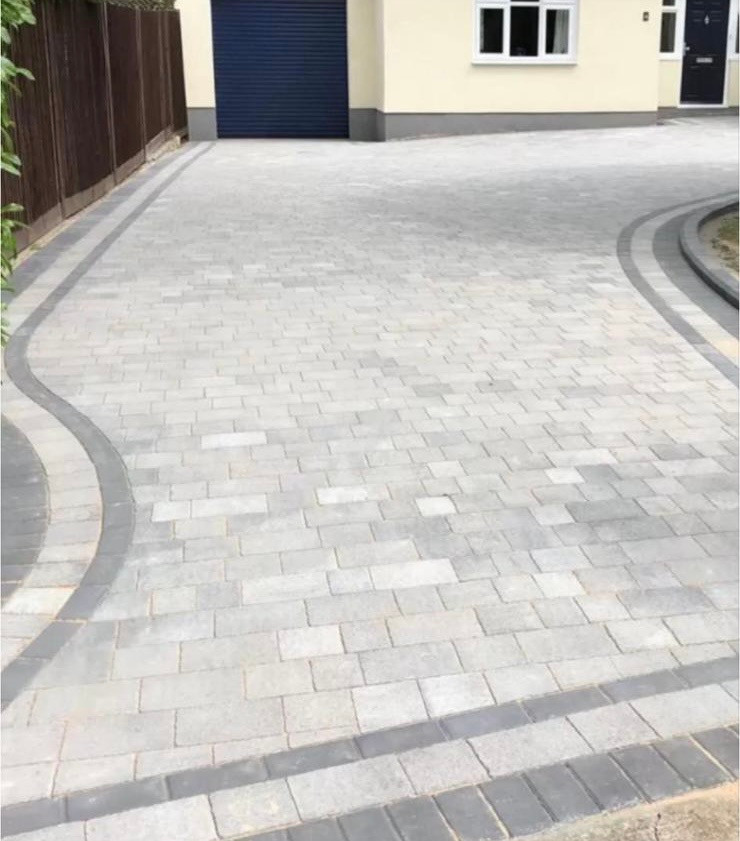
If a drive or a patio in Yarmouth is sinking, ponding or breaking up along its edges, the fault is nearly always underneath it rather than in the paving you are looking at. We come and open the ground where it matters, tell you whether you are looking at a repair or a rebuild, and put the price in writing afterwards.
The same handful of calls comes off these streets over and over. Water stands across the back of a terrace all winter and never quite clears, so the slabs have started to rock and the pointing has washed out of the joints. A front garden was given over to parking a few years ago and the blocks have rutted into two lines where the car sits.
A yard behind an old house has been surfaced and resurfaced over the years until the paving sits higher than the floor indoors, and now every heavy shower runs at the wall. Or the terrace looks perfectly sound and is lethal underfoot from November onwards.
None of those are the same job, and none of them are fixed by a new surface on its own. We come out, take levels, dig where it matters and tell you what is down there before anyone starts choosing materials. The site visit and the written quote are both free.
The work
Walled yards in the old town, and the drives out past the bridge
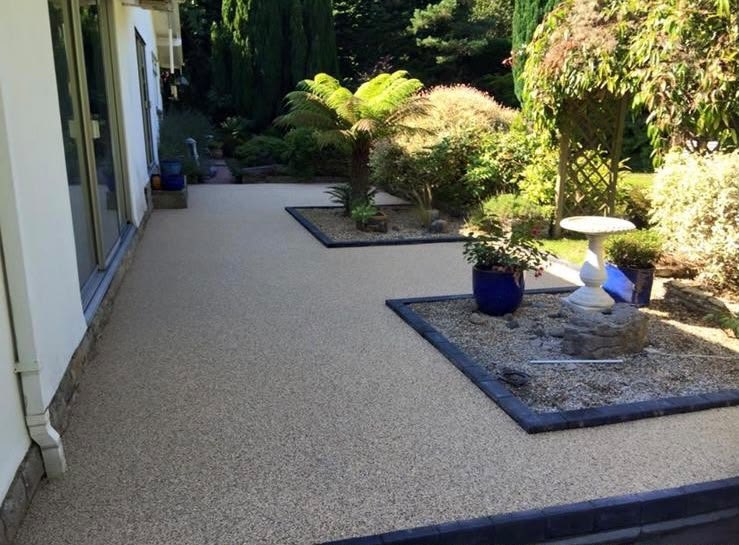
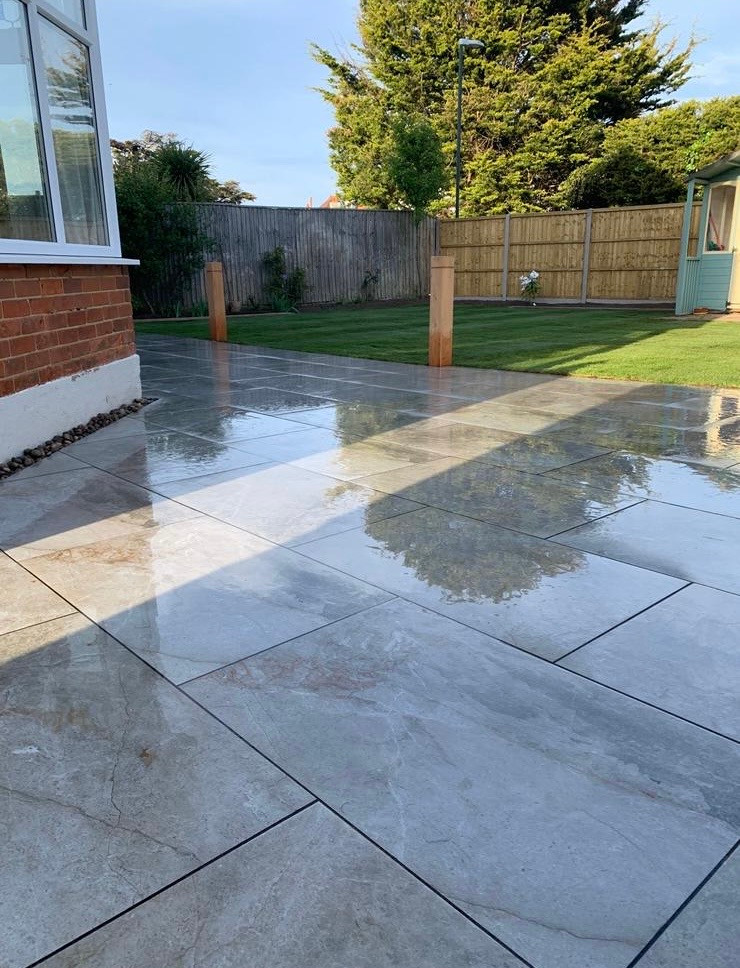
Yards and terraces a machine will never reach. A good deal of the older housing here runs straight out to the pavement, and whatever outdoor space there is sits walled in behind. That settles the job before the design does. The excavation comes out by hand, every barrow of spoil goes through a side gate or through the house, and there is nowhere for a grab lorry to stand, so the muck away is by skip or in bags. What goes down is usually natural stone or porcelain on a full mortar bed rather than five dabs, with the falls set to carry water to a channel drain instead of to the nearest wall, and the jointing worked in properly so the first wet winter does not empty it.
The level you lay at, against a wall with no damp proof course. Nearly a third of the housing here predates 1919, and in the old part of town the floor inside and the ground outside are often within an inch or two of one another. Paving brought up tight and level to the wall parks standing water against brickwork that was never built to shed it. We keep the finished level down below the threshold, run the fall away from the building, and leave a free draining gravel margin against the wall rather than butting a slab to it. Where a step has to be built to hold that level honestly, we build the step.
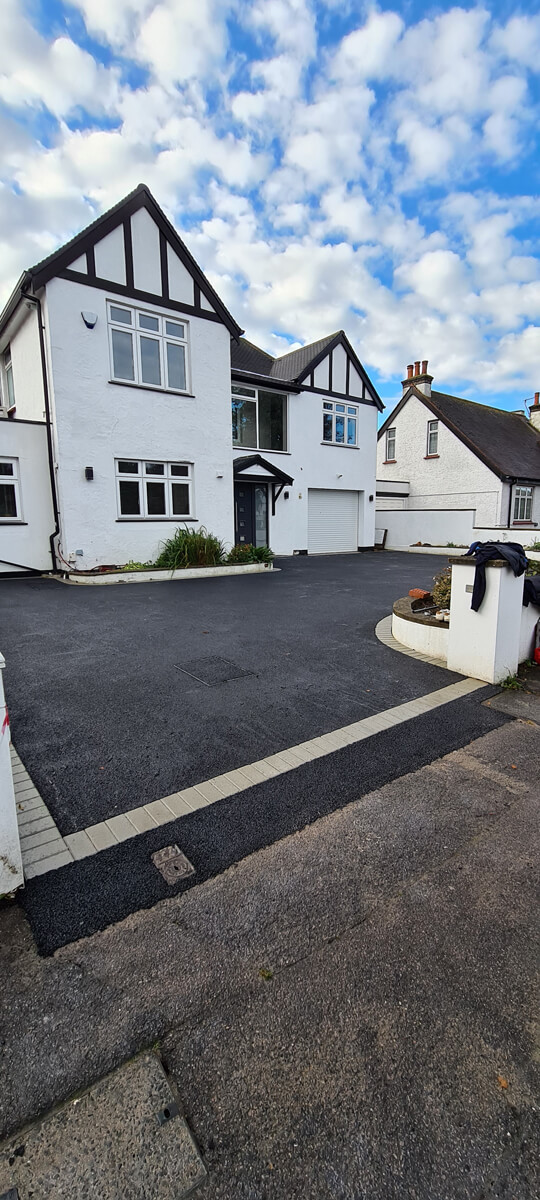
Turning a front garden into parking is common here, because the streets in the middle of town have nowhere to put a car. Done properly it is a dig to firm formation, a geotextile membrane, a sub-base compacted in layers, then block paving, resin, tarmac or concrete over it with a haunched kerb down every open side. A new opening across the footway is decided on sightlines and the verge rather than on your paving. More than a third of the homes around Yarmouth are bungalows, and a bungalow drive is nearly all width and hardly any length, so the whole of it takes wheels rather than one strip. Where a trial hole shows the base is still sound, the job is to lift, re-lay to proper falls, kerb the open edges and re-sand the jointing. We would talk you out of resin or tarmac laid straight over concrete that is already cracked and rocking, because the movement is underneath and comes back through along the same lines, and out of raising a terrace to meet a door, which cures the step and starts a damp problem.
How it runs
From your call to a written price
Taking a surface up and putting the same kind back is maintenance and needs no application. Where a front garden is hard surfaced for the first time, the Planning Portal sets the test, and it turns on water rather than area: permeable paving, or a fall taken to a bed or a tested soakaway, stays permitted development at any size, while a sealed surface over five square metres shedding onto the road does not. A new opening across the footway is a separate application to the Isle of Wight Council as highway authority, and the Planning Portal sets out what they ask for. Yarmouth carries 48 listed entries, clustered in the old town around the square and the quay.
Cost
What decides the price of a driveway
The same area of paving comes out at different prices here depending on how you reach it. A cottage near the quay with nothing but a side gate, a house on the square with its terrace walled in behind it and a bungalow out towards Bouldnor are three separate jobs, because access decides whether a machine and a grab lorry do the work or two people and a barrow do. Everything comes in and goes out by that one route. Ask what depth of stone is going down and who removes the spoil.
If it is urgent
A trip hazard, or a drive that floods
Phone rather than use the form. Here the call is usually a low walled yard where winter run-off now stands at a back step, or an edging that has let go on a shared path and taken the paving with it. We make it safe and get the water going somewhere first, and price the permanent work once the ground can be opened up.
Worth knowing
Why a soakaway is not the automatic answer here
The ground around Yarmouth does not take water away readily. It holds it. That matters more for paving than for almost anything else you might build in a garden, because a drive or a terrace has to deal with its own rainfall on your side of the boundary, and the usual way of doing that is to let it soak into the ground beneath. Where the ground will not accept it, a soakaway sized off an assumption fills up in the first wet week of autumn and then simply backs up.
You can see the result on plenty of drives on this side of the Island: a permeable surface that starts ponding, a crate soakaway that has turned into a pond in a hole, and water going instead to the lowest point it can find, which is generally a doorway. Approved Document H is the standard the design is measured against, and it expects the ground to have been tested rather than assumed.
So we run a percolation test before we design the drainage rather than after. If the ground does drain, permeable block paving over an open graded sub-base is the neatest answer, because the sub-base does the storing and there is nothing else to look at. If it does not, the water needs somewhere to go: a positive outfall into an existing surface water drain where one exists, a channel drain and a gully feeding it, or a shallow storage trench with a planted border taking the overflow.
Down on the low ground near the harbour there is the tide to allow for as well, since an outfall sitting under water at high water is not an outfall for those hours. That is the whole of SuDS in practice, and it gives you one question to put to every quote you are handed, ours included: where is this water going, and how do you know the ground will take it?
Who you are dealing with
A local firm you can check
We cover Yarmouth and the rest of PO41, over the bridge to Norton and Freshwater, out to Thorley and Bouldnor, and across the west of the Island. Bournemouth Roofing & Building Ltd, registered in England and Wales, company number 15471719, which you can look up in a minute. Thomas Hannen's business, and he is the one who comes out to price the job, not a salesman. A verified customer's 10 out of 10 on Checkatrade. The visit and the written quote are both free.
Questions
Yarmouth questions we get asked
Our terrace ponds all winter. Does the lot come up?
Not necessarily. Ponding on a terrace is either a fall that was never formed or a base that has settled in one spot, and lifting a few slabs to look underneath separates the two. Ground at Yarmouth has impeded drainage, so a bed laid without a proper stone layer settles unevenly as wet and dry seasons work on it. Where the fall is simply wrong we relay one bay and reset the levels.
Is a permeable drive worth it if the ground holds water?
It still helps, but it cannot be the whole answer. A permeable surface at Yarmouth stops rain sheeting off into the road and buys time in a downpour. Underneath, with drainage this impeded, the rain needs a stone filled cell that lets go slowly through a small outlet into an existing drain, or a wide shallow layer under the entire drive where no outfall exists. A dug pit and a stopwatch settle which.
Does salt air matter for a patio as well?
For the metal in it, certainly. At 2.9km from the coast the salt in the air at Yarmouth goes after gate hinges, balustrade fixings, channel drain gratings and any reinforcement sitting close to the surface of concrete. The paving itself is untroubled. We use stainless or plastic wherever a fixing is exposed, keep reinforcement well covered, and avoid mild steel edging strip that bleeds rust down a pale surface within two winters.
The house is pre-1900. How high can paving sit against it?
Lower than most people expect. 30.7% of Yarmouth predates 1919 and the largest single group is pre-1900, so these are solid walls that deal with damp by evaporating it out through the face. Bank a terrace against one and that face is sealed, and the moisture travels up inside instead. We keep the finished surface well down and, where a doorway will not allow it, drop a narrow open channel tight against the wall.
Can you bring a digger over on the ferry?
That is the practical question on the island, and the answer shapes the plan. Getting plant and grab lorries across to Yarmouth means a crossing each way, so we work in fewer, longer visits and hire locally where that makes better sense than shipping our own. It means we would rather price the drive and the terrace together in one go than come back twice for two small pieces of work.
Nearby, and next door
Driveways and patios near Yarmouth
Driveways and patios nearby
Our other trades in Yarmouth
Everything we do in Lymington Driveways and patios, all areas Every area we cover
Free quote
Get a written price for a drive or patio in Yarmouth
Tell us the address and what the ground is doing. We will come and look, dig where it matters, and put the price in writing.