Insulation in Yarmouth
Full depth over a bungalow ceiling, honest advice on solid walls, and the ventilation sorted at the same time.
The site visit is free and so is the written itemised quote. Thomas Hannen prices every job himself.
In Yarmouth the ceiling is nearly always the first job and often the only one worth doing this year. A large share of the housing here is single storey, so the roof sits directly over every room and the ceiling is by a distance the biggest surface losing heat. Getting it to full depth, in two layers laid at right angles, is a morning's work and it beats anything else on the list.
People ring us for three reasons. A bungalow that is expensive to heat and never quite warm at the edges. An older town house with solid walls, where one room on the weather side is cold however long the heating runs. And a loft that feels damp on a cold morning, with water sitting on the underside of the roof.
We come over on the Lymington crossing and work Yarmouth, Norton and along towards Freshwater while we are here. The site visit is free and so is the written itemised quote, ferry or no ferry. Where the honest answer is depth over the ceiling and nothing else, that is what we will put in writing.
The work
Three elevations filled, and the seaward one left
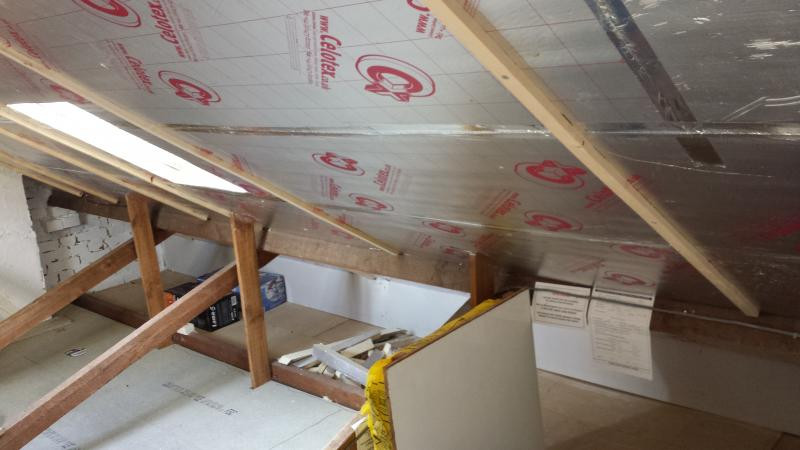
Loft depth on a single storey house. More than a third of the homes here are bungalows, and on a bungalow the loft is not one job among several, it is the job. Eco roll mineral wool between and over the joists, the second layer crossing the first so that no joist is left conducting into the room below, finishing at around 270mm. Old material that has settled or been compressed under a storage deck gets made good rather than covered over, and the decking goes back on legs above the new depth so you keep both.
Older town houses with no cavity. Getting on for a third of the housing here predates 1919, and a wall of that age is solid, with no void in it to fill. That leaves an internal wall lining or external wall insulation. Indoors it is insulated board on battens with a vapour control layer, carried into the reveals and down to the floor perimeter, because that is where the heat loss and the mould turn up if they are skipped. On a wall built to dry outwards we use a breathable build-up rather than a sealed foil faced board. There are close to fifty listed entries in the town, and on a listed building even internal work of that kind needs consent first.
On the later houses the wall is a cavity, and it gets checked rather than assumed: a small hole in a mortar joint, a camera through it, and a look at the width, the ties and whether anything is in there already. Being under three kilometres from open water matters. A seaward elevation takes driven rain hard, and a full fill is not automatically the right call on a wall in that position, so we will sometimes recommend doing three elevations and leaving one. Salt also shortens the life of metal fixings and vent components in a roof space, so fixings here are chosen for it.
Air near the coast carries moisture even when it is not raining, so a roof space here needs its airflow more than most. Rigid vent trays go in at the eaves before any quilt does, condensation on the timbers gets traced to where the moist air comes up, and the hatch gets a board and a draught seal. Where a dormer or a room in the roof leaves no loft floor, it is rigid board between and under the rafters with a clear air gap above, or a multi-layer foil quilt such as TLX where the head height is tight.
How it runs
From your call to a written price
The quote is itemised: survey, clearing, the material and its depth, ventilation works and disposal on separate lines.
Nothing inside a loft needs planning permission and insulation is normally permitted development, which Planning Portal guidance on insulation sets out; to clad or render an outside wall, Planning Portal guidance on external walls covers what is involved. Listing is the one to check here: there are close to fifty listed entries in the town and a listed building is protected inside as well as out, so we confirm the address first. regulation 23 of the Building Regulations is the other one: renovate more than half of a thermal element and the whole element comes up to current standard. Isle of Wight Council for both.
Cost
What decides the price of an insulation job
No rate per square metre. A bungalow with the hatch off the hall, a period town house where the roof space is small and awkward behind a parapet, and a top floor flat with a communal void above it are three different jobs. Old material to bag and take away, and storage to move and put back, come before anything new goes down, and Approved Document L sets what the work has to reach. Comparing quotes, ask what depth is being laid, whether the old material is removed or covered, and whether the hatch and pipework are included.
If it is urgent
Damp, condensation or a room you cannot heat
Ring rather than use the form. Condensation dripping in the loft, mould that keeps coming back, or a room that will not hold heat gets looked at quickly. Insulating a roof space that cannot breathe makes it worse, so the first visit settles which it is. We plan the crossing and order the materials in full before we start, so a job here does not sit half finished waiting on a delivery.
Worth knowing
Bungalow country, and why that changes the order of work
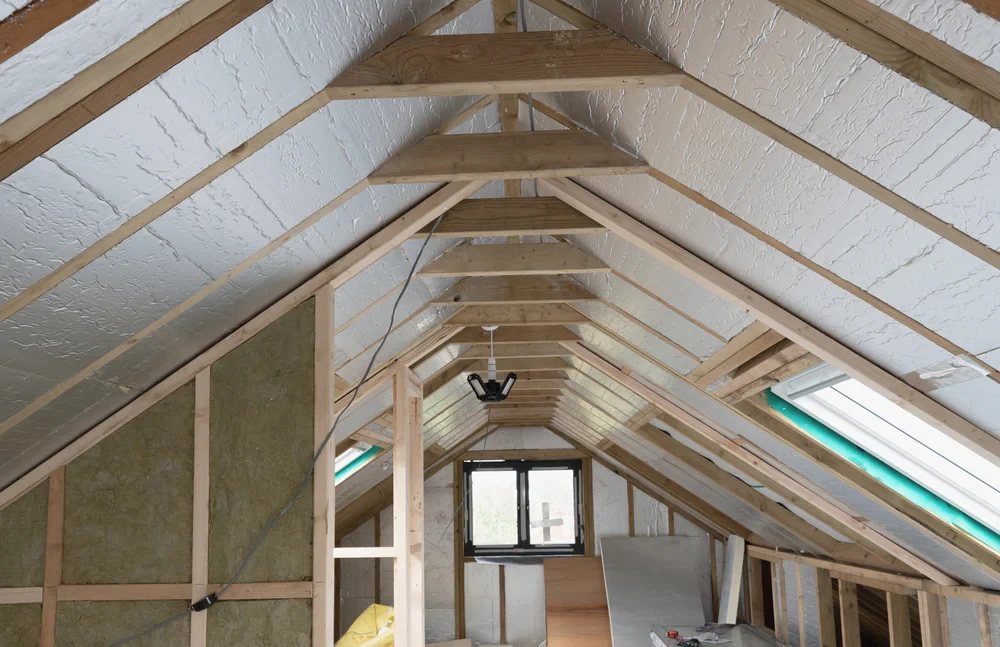
More than a third of the dwellings here are single storey, which is a much larger share than most places on our patch, and it quietly changes the arithmetic of an insulation job. Put a bungalow and a two storey house of the same floor area side by side and the bungalow has roughly twice the ceiling and twice the roof.
Heat leaves a building through surfaces, so the ceiling on a bungalow is not one of several places worth spending money, it is the dominant one. Every room in the house is directly beneath it, which is also why a patch of loft nobody could reach is felt in a specific bedroom rather than vaguely across the house.
Three practical things follow. Depth is worth paying for properly rather than stopping at the original layer, because you are covering a larger area and the return per roll is higher here than in a two storey house. Boarding matters more, since a storage deck laid straight onto the joists squashes the quilt across a large part of that ceiling, and a raised deck on legs fixes it for very little.
And the hatch is worth taking seriously, because on a bungalow it usually opens off the hall into the warmest air in the building. Where rooms have been put into the roof, the envelope changes shape and wants looking at as a whole rather than treating the flat bit and the sloping bit as separate jobs.
Who you are dealing with
A local firm you can check
We cover Yarmouth, Norton, Freshwater, Totland and the PO41 addresses along the west of the island, coming over on the Lymington crossing, with the Isle of Wight Council for planning and building control. Send the postcode if you want to be certain.
Bournemouth Roofing & Building Ltd, registered in England and Wales, company number 15471719, which you can look up in a minute. Thomas Hannen's business, and he is the one who comes out to price the job, not a salesman. A verified customer's 10 out of 10 on Checkatrade. The visit and the written quote are both free.
Questions
Yarmouth questions we get asked
Nearly a third of Yarmouth predates 1919. Does that limit us?
It limits the walls more than the loft. With 30.7% of homes here older than 1919 and 27.4% of them pre 1900, a lot of the fabric is solid and needs to dry through its own face, so sealed board on the inside is the wrong move. The roof space is a different question altogether: whatever the walls are built of, material over the ceiling is straightforward and it comes back out again.
Will the salt air change what you use on our house?
The fixings, yes. Yarmouth is 2.9km from the coast and salt carries inland on the wind, so anything ferrous around the roof edge gives up early: nail heads, clips, grille mesh, the screws holding a soffit vent. It shows as rust staining well before it shows as a failure. Where we fit trays or vents at the eaves we use non ferrous, and we check the existing ones rather than assume.
Over a third of Yarmouth is bungalows. Is the loft bigger than we think?
Almost certainly. 35.7% of homes here are single storey, which puts the whole plan of the house under one ceiling instead of half of it. Two things follow from that. There is more ground to cover than people picture from the driveway, and the run of eaves round the outside is long, so the fiddly perimeter work takes up more of the day than rolling out down the middle.
The George Hotel is listed. Does that affect the houses near it?
Not by itself. Standing next to a listed building only matters if your own property falls within its curtilage or is listed in its own right, and Yarmouth has 48 entries including The George Hotel and the parish church, so it is worth checking rather than assuming. Where a house is listed, insulation over a ceiling is generally fine and altering the roof covering is not.
Who do we apply to over here if work shows outside?
The Isle of Wight council, not Dorset. Yarmouth has no conservation area of its own, but the island carries a landscape designation, so anything visible gets weighed on how it sits in the view. External wall insulation and new rooflights are the usual sticking points. Nothing inside the roof space is caught by any of it, which is why the loft is where we start on this side of the water.
Nearby, and next door
Insulation near Yarmouth
Insulation nearby
Our other trades in Yarmouth
Everything we do in Lymington Insulation, all areas Every area we cover
Free quote
Get a price for insulation in Yarmouth
Tell us the address and what the house is doing in winter. We will come over and look, and put a price in writing. Neither costs you anything.