
Bricklaying and repointing in Yarmouth
Lime repointing, brick repair, chimney stacks, garden walls and new brickwork across Yarmouth, Bouldnor and the PO41 lanes.
The site visit is free and so is the written itemised quote. Thomas Hannen prices every job himself.
In Yarmouth the wall usually tells you which mortar it wants before anybody gets a ladder out. The old streets behind the quay are solid walls with no cavity, and they want a soft breathable lime. The postwar bungalows out towards Bouldnor and Norton are cavity work and go back in a matched sand and cement.
Three things bring people to ring us from this end of the Island. The joints in the bottom few courses of a bungalow have washed back to sand and the wall is damp inside. A brick face on a period wall has started coming off in flakes, usually a year or two after somebody pointed it in hard grey mortar. Or a wall near the water has loosened at the top, a coping has shifted, and it wants making safe before the next blow.
All three are readable from close up and none of them are readable from a photograph, which is why we come and survey the wall rather than price it off a message. We look at the top of a wall and the bottom of it as hard as the middle, tell you which elevations genuinely need doing this year, and put it in writing elevation by elevation. The site visit and the written quote are both free.
The work
Repointing, blown faces and new walls in Yarmouth
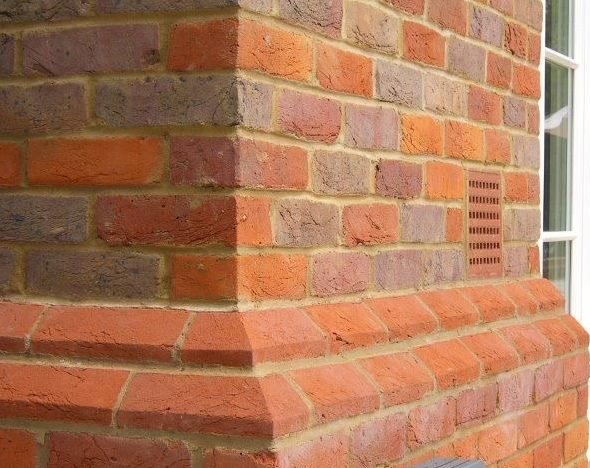
Repointing in the streets behind the quay. The old core of the town is solid wall, one unit thick with nothing behind it, and 30.7 per cent of Yarmouth's housing predates 1919 with the peak of it before 1900. On that fabric the joints are raked by hand rather than with a disc cutter, back to twice their width, and go back in lifts in a breathable lime mix kept softer than the brick. The profile is a decision rather than a habit: weather struck on the elevation that takes the rain off the water, flush or bucket handle on the sheltered sides where the arris is worn and a struck joint would sit proud of it. Three kilometres from the sea, salt keeps a wall damp between showers instead of letting it dry, so the seaward face is usually the one that has gone.
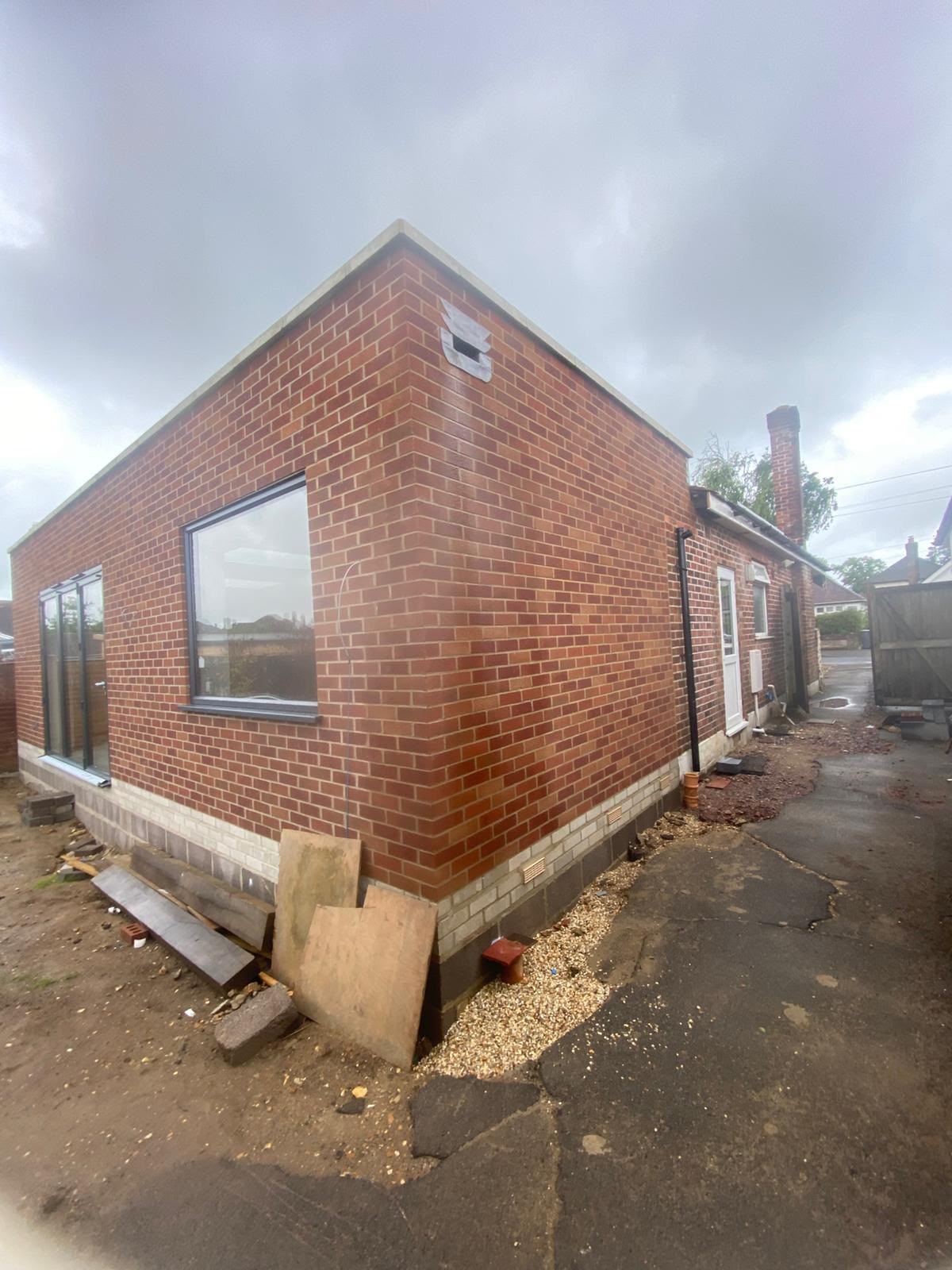
The bottom four courses of a bungalow. Bungalows are 35.7 per cent of the town, and the eaves overhang shades the top of the wall while the ground goes to work on the bottom of it. Most bungalow repointing we price here is in the plinth and the first few courses above the path, where rain splashes back off a hard surface. Where a patio or drive now sits above the damp proof course, water bridges it and the damp turns up inside. Pointing that wall without dropping the level back is money spent twice, and we say so on the visit.
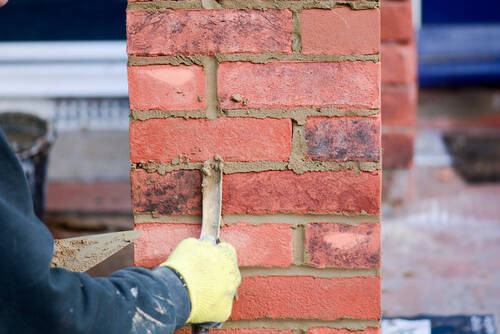
In the post-war cavity stock the ties corrode sooner this close to salt air than they do inland, showing as fine horizontal cracking that repeats every few courses or one panel bulging out of line. Stainless ties go in from outside a few at a time and the holes are made good in a matched mortar, and cracked lintels over the wide windows of that era are cut out and replaced rather than filled and painted. Blown bricks are cut out one at a time and replaced in a match, and a reclaimed brick has to be ordered before the scaffold goes up, because nothing gets fetched mid week from here. A boundary wall near the water takes wind and salt on both faces, so a lifted or hollow coping is the first thing we check, ahead of the joints, and a wall holding a level change gets weep holes and drainage behind it. Stacks get repointed and the top courses rebuilt, and a redundant stack is capped with ventilation rather than sealed with the damp shut in.
How it runs
From your call to a written price
Repointing and like-for-like brick repair count as repair, so at most Yarmouth addresses there is nothing to apply for and building control does not get involved. The Isle of Wight Council is the planning authority here, and there are 48 listed entries inside a town this size, from the church to the George Hotel, so it is worth checking your own address before anybody starts. On a listed building the mortar mix and the joint finish are part of what consent covers, and consent is a separate application from planning permission. Planning Portal guidance on external walls sets out where repair stops and alteration begins, and where a wall is shared with next door Party Wall etc. Act 1996 puts a notice period on the work.
Cost
What decides the price of a brickwork job
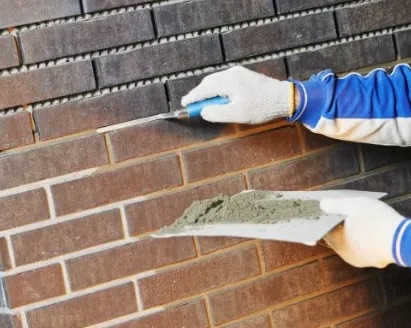
No rate per square metre. Access first: a cottage gable in the old streets, a bungalow elevation off the Bouldnor road and a garden wall you can walk straight up to are three different jobs. How long the platform stands matters as much as its size, and work at height rules are why it is a priced line. Matching a brick means sourcing it, and on the island that means ordering before the scaffold goes up. Ask what the mix is and whether the scaffold is included.
If something has moved
Loose brickwork, or a wall that has shifted
Ring rather than use the form. Anything overhead or leaning jumps the queue, and the first visit is about making it safe. The two that will not wait here are a garden wall leaning over one of the narrow pavements in the old town, and a stack that has opened up at the flaunching. The phone is answered 24 hours for emergencies; scheduled work runs Monday to Friday, 8am to 6pm.
The one local thing
The ground moves with the seasons, and your downpipes decide how much
The ground in and around Yarmouth is cohesive rather than free draining, with a real shrink and swell rating on it. Cohesive ground takes up water through the winter and gives it back in a dry summer, and it changes volume while it does. Foundations sitting in it rise and fall a little every year.
On a shallow period footing, or on the shallow foundation of a nineteen sixties bungalow, that shows up in the brickwork as cracking which opens through late summer and closes again by spring, usually stepped along the joints near a corner or running away from the top of an opening. That is not the same thing as a wall that is genuinely failing, and it wants a different answer: stitch and point a crack that moves with the seasons, and only start talking about rebuilding when a crack keeps growing in one direction year on year.
What changes what you should do is where your rainwater ends up. A downpipe running into a silted gully, a shoe spitting onto a border, or a soakaway sited a metre from the wall all put a winter of roof water into the ground right beside the footing, which is exactly where cohesive ground swells hardest.
Getting the water away is often the actual repair, and pointing the crack before you sort the water buys you a year at most. Approved Document H sets out what surface water is supposed to be doing. A thirsty tree closer to the house than its own height pulls the other way, drying the ground out in summer. We will tell you on the visit whether what you have is a brickwork job, a drainage job or one for a structural engineer.
Who you are dealing with
A local firm you can check
We work Yarmouth, Norton, Bouldnor, Thorley and the PO41 addresses either side of the river, with the Isle of Wight Council for planning and building control, and materials come over on the ferry with us at the start of the job rather than being fetched halfway through the week.
Bournemouth Roofing & Building Ltd, registered in England and Wales, company number 15471719, which you can look up in a minute. Thomas Hannen's business, and he is the one who comes out to price the job, not a salesman. A verified customer's 10 out of 10 on Checkatrade. The visit and the written quote are both free.
Questions
Yarmouth questions we get asked
Does the crossing to the Island complicate the job?
It makes it a planned job rather than a drop in. Yarmouth is 16.8 miles from base and across the water, so materials come over in one load and the work is booked as a solid run of days instead of odd mornings. Thomas still comes across and prices it himself, at no charge. What it does mean is that the specification has to be settled before the van is loaded.
We are 2.9km from the sea. Why are the brick faces flaking?
Salt crystallising behind the face. At 2.9km inland the wind still carries plenty of it, and on Yarmouth's older brickwork, where 30.7% of the stock predates 1919, the face is soft enough for those crystals to lift it away in flakes. The joints can look sound while the bricks between them fail. Those get cut out singly and replaced, with the new mortar softer than the brick around it.
Should a stepped crack above a window worry us?
It depends whether it moves. On the cohesive ground under Yarmouth a crack that opens in a dry summer and closes again over winter is seasonal, and stitching and pointing it is the whole job. One that keeps widening month on month, or is wider at the top than the bottom, points at the foundation and wants a structural engineer ahead of a bricklayer. I would mark it and measure it.
Our patio sits above the damp proof course. Does it matter?
It matters more than most people expect. Once paving sits above that line, water crosses into the wall above the barrier and no amount of pointing will stop it. Around Yarmouth the ground has impeded drainage, so the paving holds water against the brick instead of letting it away. The usual answer is a channel cut back along the wall with a drainage gap, then the affected courses pointed.
Who deals with permission on the Island?
The Isle of Wight Council is the planning authority for Yarmouth, so anything requiring consent goes to them rather than to a mainland council. For repointing that almost never arises. It does arise on the 48 listed buildings in the town, the George Hotel and the parish church of St James among them, where consent covers the mix and the joint finish as well as the work. Status gets checked before pricing.
Nearby, and next door
Bricklaying and repointing near Yarmouth
Bricklaying and repointing nearby
Our other trades in Yarmouth
Everything we do in Lymington Bricklaying and repointing, all areas Every area we cover
Free quote
Get a price for your Yarmouth brickwork
Send the postcode and a photograph of the wall you are worried about. The site visit is free, the quote is itemised, and Thomas comes over to price it himself.