
Bricklaying and repointing in Freshwater and Totland
Repointing, brick repairs, chimneys and garden walls across Freshwater, Totland and the PO40 lanes, starting with the face that takes the weather.
The site visit is free and so is the written itemised quote. Thomas Hannen prices every job himself.
In the west Wight the joint is the drain. Walls at Freshwater and Totland take driven rain on the south west face and get rid of it by letting it evaporate back out through the mortar, which is why a hard cement pointing on an old wall does more damage over ten years than the weather managed on its own.
Three things bring people to ring. Mortar washed out of the seaward face of a villa or a terrace above the bay, while the sheltered side still looks new. Brick faces spalling off that same elevation, which is what happens next once the joints have gone. And a coping or a chimney stack that has been worked loose by wind.
The pattern is always the same: one elevation is years ahead of the others. That is worth knowing before you pay for anything, because the sensible money goes on the face that takes the weather, done all at once, rather than spread thinly round a house that does not need it yet. We survey all of it and tell you which is which.
The work
What we take on above the bays
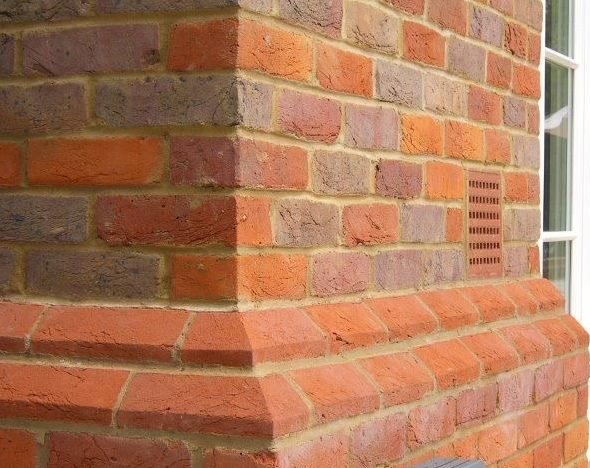
Solid walls, and the profile of the joint. Over a quarter of the housing here predates 1919, so the older villas and terraces are solid brick with no cavity, some with stone dressings round the openings. The joints come out by hand rather than with a disc, back to about twice their width, and go back in lifts in a natural hydraulic lime mix, usually NHL 3.5 with a sharp sand and kept weaker than the brick. The profile is a decision, not a habit: weather struck on the south west face, which is the one taking the driven rain here, and flush on the sheltered ones. A recessed joint looks handsome in a photograph and holds a bead of water on a wall like this.
Once the joints have opened, driven rain soaks the wall, the frost gets into the saturated face and the front of the brick comes off in flakes. Blown bricks are cut out one at a time and replaced with a reclaimed match, laid to the same bond and pointed in with the rest. We put up a sample panel first, because colour and weathering both matter on an elevation you look straight at from the road.
A lot of seaward elevations here were rendered or dashed to keep the weather out, and where that has cracked the water gets behind it and cannot get away. The brickwork behind gets cut back to sound material and repointed before anything new goes over it. A rigid sand and cement render on an old solid wall is a short term answer that stores the problem up in the brick. The top of a wall is where wind does its work as well: copings lift, flaunching cracks, stacks lose their joints, and once the cap is off water runs down into the core. Stacks are repointed or rebuilt above the roof line off a scaffold, and copings go back brick-on-edge with a proper weathering, bedded to stay put.
The ground here shrinks and swells, so where rainwater ends up beside a foundation is a structural question and not just a damp one. A wall holding a level change needs weep holes and drainage behind it or it stays saturated and the joints wash out from the back. Gate piers are rebuilt plumb off their footing, and a wall that has moved is taken down and rebuilt rather than stitched where the movement is live.
Bungalows and converted villas. Nearly three in ten dwellings here are bungalows, and the cavity built ones along the lanes get corroded wall ties, which show as level cracking repeating every few courses, and cracked lintels over wide openings. A fifth of the stock is flats, a good many of them in the big villas, and the outside of a flat belongs to the freeholder, so on those the instruction comes from the freeholder or the managing agent rather than the resident. New work, extensions and porches go up in blockwork and cavity with stainless ties, a DPC and weep holes, and brick matched to what is already on the house.
How it runs
From your call to a written price
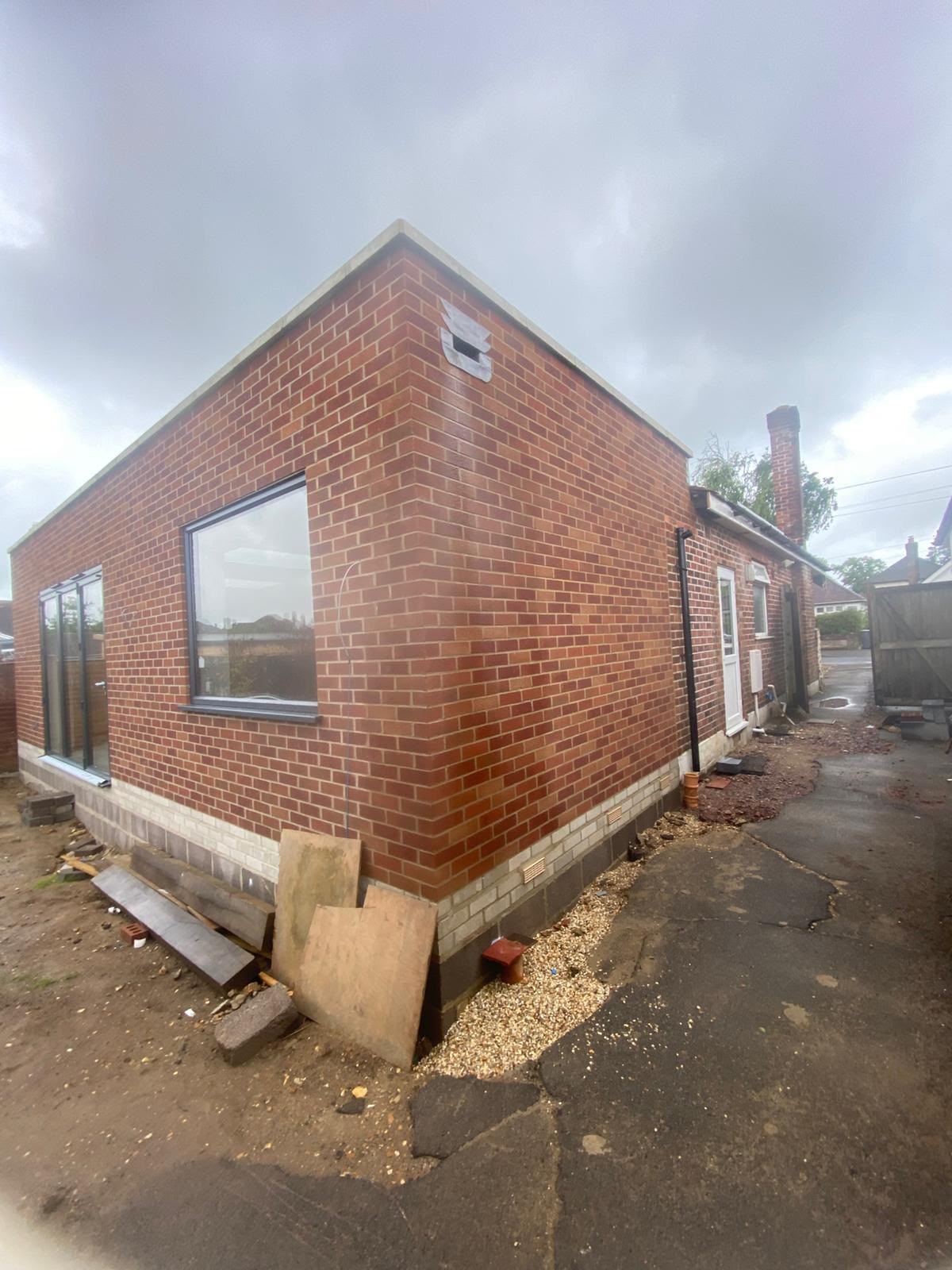
Same team from the first visit to the last, one person to ring, and the quote itemised: access, raking out, the mortar mix, the area of each elevation, any brick replacement and disposal on separate lines. The Isle of Wight Council is the planning authority here. There is no conservation area over Freshwater and Totland itself, but there are 29 listed entries in the parish, Weston Manor and Farringford among them, and on a listed building consent is a separate application from planning permission and covers the mortar as much as the brick. Otherwise repointing and like-for-like brick repair are repair, and the Planning Portal guidance on external walls sets out where that stops.
Cost
What decides the price of a brickwork job
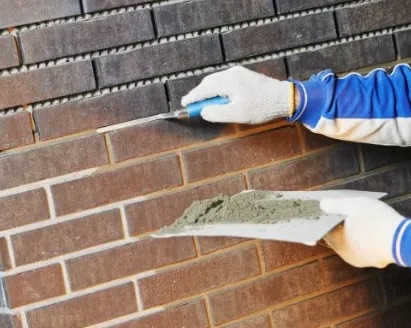
No rate per square metre: the metre of wall tells you nothing until you see the joints. A three storey villa above the bay, a bungalow along a lane and a stack on a terrace are three different problems of access. How long the platform stands matters as much as its size, and the work at height rules are why it is a priced line. Raking by hand is slow, so joint depth and spalled faces decide the hours, and matching a mortar or sourcing a brick takes trial panels. Ask how deep joints are raked, by hand or disc, and whether the scaffold is in.
If something has moved
Loose brickwork, or a wall that has shifted
Ring rather than use the form. Anything overhead or leaning goes to the front of the queue. Here that is usually a coping, a parapet or a chimney after a blow, and the wind gets up on this corner of the Island more often than it does inland. The first visit is about making it safe. The phone is answered 24 hours for emergencies; scheduled work runs Monday to Friday, 8am to 6pm.
The local part
The south west face takes everything, and it goes first
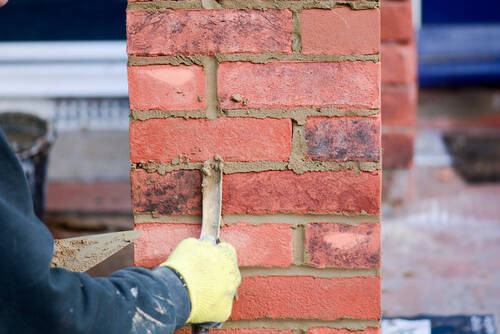
The most exposed elevation here faces south west with nothing between it and the water, so a wall in Freshwater or Totland gets far more days of wind-driven rain than a wall a few miles inland. Rain driven at a wall does not run off it, it goes in.
On a solid wall with no cavity the only route back out is evaporation through the mortar and the brick face, which is the entire reason these walls were pointed in lime in the first place. Seal that route with a hard cement joint or a plastic-based masonry paint and the water still gets in. It just leaves through the inside of the room instead, and the brick faces spall where the moisture is forced out.
What that means when you are deciding what to have done. Start with the south west face and do all of it. Get the joint profile right rather than just full, because a weather struck joint sheds where a recessed one holds water against the brick.
And look at the top of the wall as hard as the middle: most of the damage on a coping or a parapet here begins with a cap lifted by wind, after which water runs straight down into the core. If you only have one elevation done this year, have the one you can hear the weather on.
Who you are dealing with
A local firm you can check
We work across the west Wight, Freshwater, Totland, Norton, Yarmouth and the PO40 addresses, with the Isle of Wight Council for planning and building control, and we plan the crossing around the work so the days on site are full ones.
Bournemouth Roofing & Building Ltd, registered in England and Wales, company number 15471719, which you can look up in a minute. Thomas Hannen's business, and he is the one who comes out to price the job, not a salesman. A verified customer's 10 out of 10 on Checkatrade. The visit and the written quote are both free.
Questions
Freshwater and Totland questions we get asked
Our cottage predates 1900. What mortar goes back on?
Lime, matched to what is already in the joint. 27.5% of Freshwater and Totland stock predates 1919 and the single largest group is pre 1900, which means solid walls with no cavity that shed water by drying out through the mortar. A cement mix seals that route and pushes the moisture out through the brick or stone face instead, taking the surface with it. We take a sample from a sheltered joint, match the sand and the colour, and keep the new mix softer than the wall.
Does coming across on the ferry change how you schedule?
It changes the shape of the week rather than the work. Island jobs get booked in runs so the crew and the materials cross together and stay put, which means a single repair in Freshwater South may wait for the next run rather than being slotted in on a Tuesday morning. Thomas Hannen comes over to look and price before any of that is arranged. Once we start we see the job through in one go rather than coming and going.
Why is the seaward side of our wall worse?
Because that side gets the driven rain. The most exposed elevation here faces south west into open water, and wind driven rain works at the arrises, the reveals around openings and the top few courses rather than the middle of a flat surface. Those joints then stay wet between showers and never properly dry. Repointing the weather face on its own is a legitimate repair, so we usually price that elevation and leave the sheltered walls until they actually need it.
Our downpipe discharges beside the wall. Is that a problem?
On this ground it is more than a damp nuisance. Freshwater sits on cohesive soil rated significant for shrink and swell, with slightly impeded drainage, so earth that is soaked and then dried out changes volume and whatever is built on it follows. A gulley spilling at the foot of a wall is a common reason for stepped cracking near a corner. We look at where the rainwater ends up before we look at the crack, because otherwise the repair fails the same way.
There are 29 listed entries locally. Are we caught by that?
Only if your own building is on the list. The entries here take in Weston Manor and Farringford Hotel, and neither Freshwater nor Totland has a conservation area of its own, so most houses can be repaired without any application at all. Standing near a listed building puts no control on your wall. Isle of Wight Council will confirm the position if you want it in writing, and we check it ourselves rather than finding out halfway through.
Nearby, and next door
Bricklaying and repointing near Freshwater and Totland
Bricklaying and repointing nearby
Our other trades in Freshwater and Totland
Everything we do in Lymington Bricklaying and repointing, all areas Every area we cover
Free quote
Get a written price for your west Wight brickwork
Send the postcode and a photograph of the elevation you are worried about. The site visit is free, the quote is itemised, and Thomas comes out to price it himself.