Exterior cleaning in Freshwater and Totland
Roof cleaning, render and masonry soft washing, gutters cleared and paving brought back across the West Wight. We look at it properly before we price it.
The site visit is free and so is the written itemised quote. Thomas Hannen prices every job himself.
At Freshwater and Totland the first job is telling dirt from damage. A wall in the West Wight that looks filthy is often a wall that is holding water, and washing it will make it look better for a fortnight without touching the reason. We look before we quote, and we will tell you when cleaning is not the answer.
The usual reasons people ring are simple enough. The seaward face of the house has gone dull and chalky while the sheltered face has gone green. A slate or tile roof is furred with lichen and somebody in the pub has said it needs replacing. The path or the patio is slippery from the first autumn gale onward.
Or the gutters have not been cleared in years and there is a stain running down the render below. We survey each surface on its own and say what will come up with a wash, what needs treating and then time to work, and what we would leave alone entirely. The site visit is free and the written price puts each surface on a separate line, so you can take the parts that matter now.
The work
What the West Wight puts in front of us
Painted render and stucco. Better than a quarter of the housing across Freshwater and Totland went up before 1919, and much of it is rendered and painted, often repainted many times over. That surface is soft washed at low pressure with the product doing the work. A jet wash strips paint, opens hairline cracks and drives water into a wall that will take days to give it back. Where the paint is already blistering we say so and stop, because washing a coating that has lost its grip just takes more of it off.
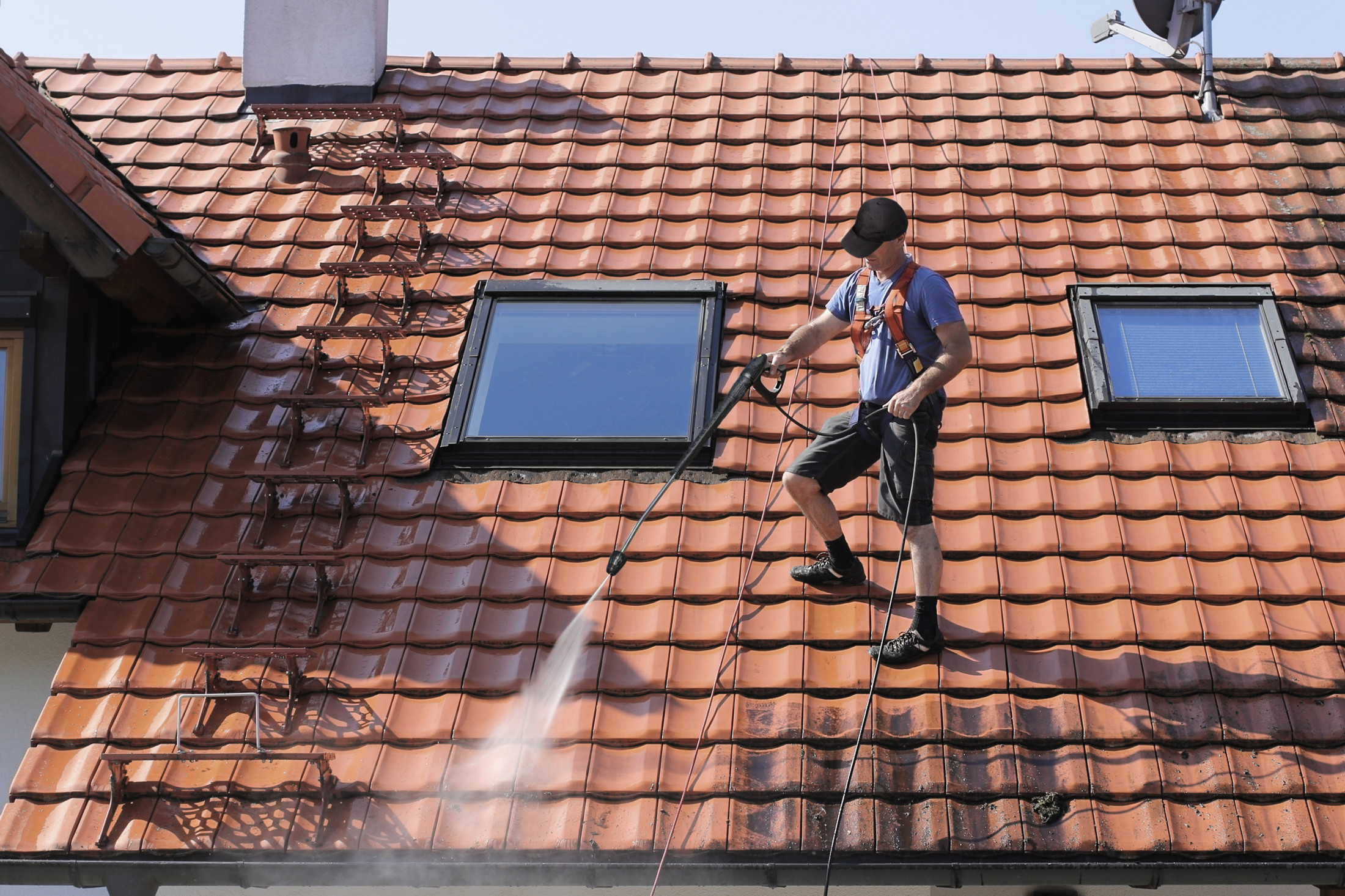
The older roofs here are slate or small clay tile and they are the ones people most often get wrong. Slate is brittle, nails corrode in this air, and a slipped slate under a boot costs more than the clean. So they are worked from a ladder or a pole rather than walked, growth is eased off dry, and the surface is soft washed and treated with a biocide to slow the regrowth. Lichen on slate never fully disappears, and anyone promising you otherwise has not cleaned much slate.
Close to three in ten dwellings here are bungalows, and they and the later estates carry interlocking concrete tile that holds moss deeply on the shaded slopes. That is scraped dry, soft washed at low pressure, treated so the spores in the surface do not bring it straight back, and nothing is forced up under the lap. A bungalow also puts most of the roof and the gutter within reach of a pole from the ground, which changes how the day is planned.
A lot of the older houses still run cast iron gutters and downpipes, which are cleared and washed by hand rather than pressure washed, since the paint on them is the only thing holding the rust off. Outlets are rodded, joints checked, valleys cleared first, and the inside photographed before and after. The most exposed elevation faces south west, and wind and driven rain work at the edges and the openings rather than the middle of a surface, so that is where the staining starts.
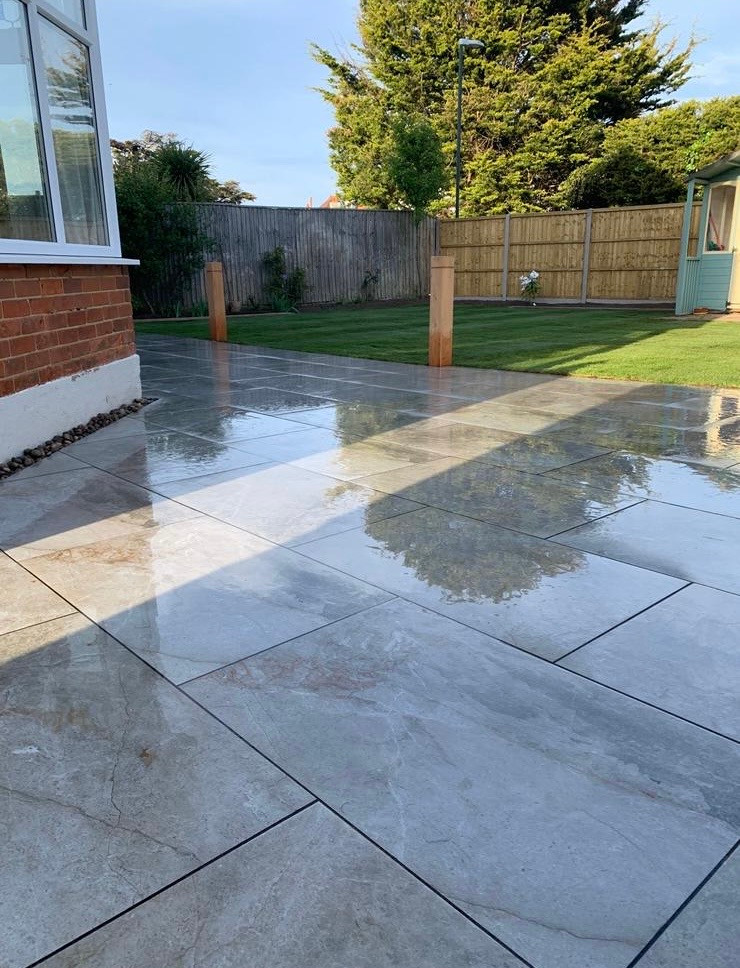
Paving, steps and sea walls. Brick paths, slabs, concrete and block paving are where a pressure wash and a rotary nozzle are the right tool. Block paving is re-sanded after washing. Steps and sloping paths get the treatment as well as the wash, because on this coast they are green again by the next winter otherwise. Sealing is a separate decision and only works on genuinely dry paving, which this close to the Channel is not most weeks of the year. Everything we spray is a biocide sold for the surface and used to its label, which is what the biocides regime the HSE administers requires.
How it runs
From your call to a written price
Cleaning is maintenance, so there is no application to make and no building control to involve, wherever you are in Freshwater or Totland. The parish does carry a couple of dozen listed entries, mostly the larger old houses rather than the ordinary streets, and on those any coating, sealant or change of colour is a separate question to settle before the work rather than after it. Planning Portal guidance on external walls sets out where maintaining a wall becomes altering one.
Where the water goes is planned on every job: planting sheeted or soaked first, gullies and drains protected and residue contained, in line with pollution prevention guidance.
Cost
What decides the price of a clean
No rate per square metre: the same square metre can be twenty minutes or two, depending what is growing on it. A rendered villa on a corner plot with wind straight off the Channel, a mid-terrace with no side access and a bungalow you can walk a pole right around are three different jobs. Some of it wants a tower rather than a pole, and work at height rules decide which.
Comparing quotes. Ask what method each surface gets, whether treatment is included or only a rinse, whether a second visit is part of it, and where the run off goes.
If there is a date
A viewing, a visit or a deadline
Ring rather than use the form. It is not emergency work, but it usually has a date on it: a sale, an inspection, scaffolding coming down. Tell us the date and we will say honestly if it can be done properly. Say if it is a holiday let changeover, because lining up a crossing and a working day needs the notice. The phone is answered 24 hours for emergencies; scheduled work runs Monday to Friday, 8am to 6pm.
One local thing
Old walls, and the cement render put over them
A large share of the housing here is pre-1900, and those walls were built solid, without a cavity, out of stone rubble or soft brick bedded in lime. A wall like that is meant to take up water in a gale and let it out again when the wind drops. Everything about how it is cleaned follows from that.
Low pressure, a weak solution, dwell time instead of force, and no sealant afterwards, because a sealant is a lid on something designed to breathe and the water simply leaves on the inside instead. If the pointing has gone, the mortar is the job and the clean can wait.
The complication in the West Wight is what the twentieth century did to those walls. A great deal of the old fabric was given a hard cement render at some point, sometimes with a coating over the top of that, and cement over lime traps water rather than shedding it. When it fails it does not fall off politely. It blows into hollow patches that sound like a drum when you tap them, cracks along the line of the render rather than the brick, and stains dark exactly where the trapped water sits.
People ring us to clean that stain. Washing it changes nothing, and a lance will take the loose render off the wall in sheets. So before we price a rendered old house we tap it. If it is sound you get a clean and a treatment. If it is blown you get told which elevations have gone and roughly how far, so you can decide whether you want rendering work first, which is a different trade and a different quote. That is a duller answer than a cheap wash and it is the one that saves you money.
Who you are dealing with
A local firm you can check
Freshwater, Totland, Norton and Yarmouth in the PO40 postcodes, worked from our base on the mainland and booked in runs so a crossing covers a full day's work. Bournemouth Roofing & Building Ltd, registered in England and Wales, company number 15471719, which you can look up in a minute. Thomas Hannen's business, and he is the one who comes out to price the job, not a salesman. A verified customer's 10 out of 10 on Checkatrade. The visit and the written quote are both free.
Questions
Freshwater and Totland questions we get asked
Do you actually come over to the Island for one house?
Yes. The crossing gets booked like any other travel, so we group Freshwater and Totland work into one trip rather than making single runs for one gutter. That means a window rather than a next day slot, and we would rather look at two or three jobs on the same day than one. Thomas Hannen comes over and prices it himself, and the site visit and the written quote cost nothing.
Our walls are solid and lime rendered. Is washing safe?
Only if the method suits them. Just over a quarter of the housing here, 27.5%, predates 1919, and those walls have no cavity behind them and rely on drying outward. A jet drives water into the lime and it stays there for weeks. We wash at low pressure with a biocide, work from the top down, and let the wall dry rather than scouring it back to bare mortar.
Why is one gable green and the rest of the house fine?
That gable is the one taking the weather. The most exposed elevation here faces south west, and driven rain hits the corners and the window heads on that side long before it wets the middle of a wall. Algae follows the water. We generally treat that elevation and leave the sheltered ones, which keeps the job in proportion to what is actually dirty and keeps you off a second visit.
The patio stays wet for days. Is that a cleaning job?
Partly. The ground under Freshwater drains slowly, so a slab bedded on it holds damp underneath and greens over again faster than the same slab on sand and gravel. Washing will lift the green and the slip with it. If the joints pump mud when you walk on them, that is a laying fault and cleaning only makes it obvious. We say which of the two you have before quoting.
Farringford is listed. Does that affect ordinary houses nearby?
Not unless your own house is one of the 29 listed entries in the parish, and most are not. Weston Manor and Farringford Hotel carry a listing; the bungalow next door does not, and no conservation area covers Freshwater or Totland. Washing a wall is maintenance in any case. Where it does reach is attached structures, a boundary wall or an outbuilding belonging to a listed entry, because those are caught as well.
Nearby, and next door
Exterior cleaning near Freshwater and Totland
Exterior cleaning nearby
Our other trades in Freshwater and Totland
Everything we do in Lymington Exterior cleaning, all areas Every area we cover
Free quote
Get it looked at before you pay to wash it
A free site visit in Freshwater and Totland, then a written itemised price with every surface on its own line. Tell us your date and we will book the run around it.