Flat roofing in Yarmouth
Sun lounge, kitchen and garage roofs around Yarmouth and Norton, built warm where there is a room underneath.
The site visit is free and so is the written itemised quote. Thomas Hannen prices every job himself.
There are more bungalows here than anything else, and on a bungalow the flat roof is rarely over a car. It is over a sun lounge, a kitchen or a converted garage. That settles the specification before the covering is even discussed, because a roof over a heated room gets built warm.
The town runs from Georgian frontages in the old streets, where a small flat behind a parapet may still be lead, out to sun lounges and garages added in the seventies. Two very different roofs, and two very different jobs.
The calls are a stained ceiling, a sun lounge streaming with water every winter, or felt gone grey and split along a lap. We get up, lift a corner where it is safe, look at the deck and the outlet, and ask what the room below is used for before recommending anything at all.
By age of roof
Lead in the old streets, felt on the post war work, fibreglass on the rest
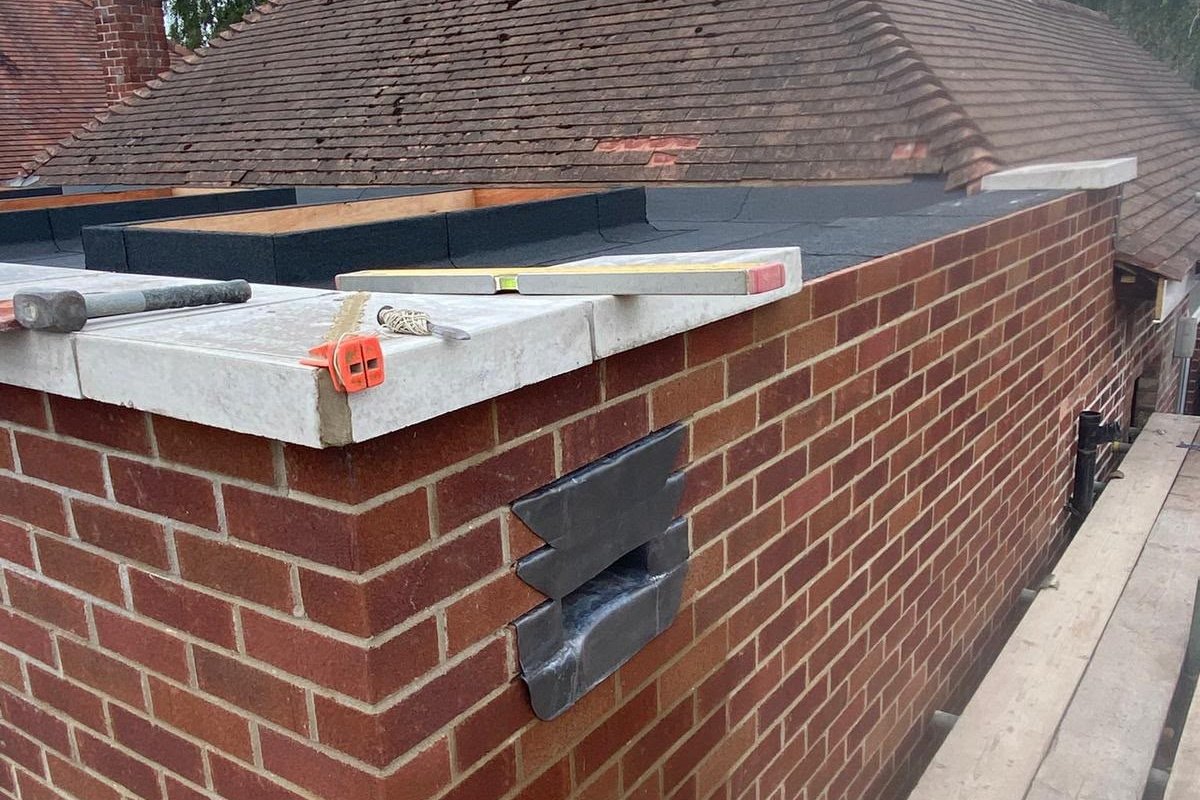
The old flats behind a parapet. In the old streets there are small lead flats over a bay or set behind a parapet still doing their job, and we would rather say so than strip one. Lead that has split at a roll, or whose drips have flattened, can be dressed and patched. Where it has genuinely gone, the honest question is whether to relay in lead or turn it into a rubber or fibreglass roof, and on a listed building that gets settled before anything is ordered. The coping, the cavity tray behind it and the upstand behind the covering leak far more often than the flat itself does.
Post war additions, and the seventies sun lounge. This is most of the work. A cold roof with insulation dropped between the joists, a dead void above it, and a built up felt covering that has done its time. The covering goes back as three layer torch on felt under a mineral cap sheet, as EPDM rubber laid in one sheet with bonded laps, or as single ply hot air welded where the span is long. The build up goes as well wherever there is a heated room underneath, because a ventilated cold roof beneath a sun lounge gathers condensation and interstitial damp. A warm roof with PIR above the deck and the vapour control layer beneath it keeps the dew point clear of the timber. BS 6229 sets it out and Approved Document L sets the level.
The recent work, and what sits under all of it. Newer roofs are usually GRP fibreglass, formed in place over new ply and cured into one skin, and they crack at a sharp internal corner where the deck has been flexing rather than out in the open field. That is a deck fault, not a covering fault. Under any of the three you find plywood, OSB, chipboard or plain boarding, and chipboard swells the first time it gets wet and stays swollen. Firrings over the joists, or tapered insulation inside a warm roof, put a fall back so the surface drains at the rainwater outlet instead of ponding.
The edges, whatever the age. The upstand against the house wall, the abutment with its lead cover flashing dressed into a chase, the drip and apron at the front edge, the edge trim whose fixings have pulled in a blow off the water. A skylight, a lantern, a Velux, a hatch, a soil pipe or a vent pipe each want a kerb or a collar. Then the gutter, hopper and downpipe are cleared and run through before the covering takes the blame. A garage is a day. A sun lounge with a new deck and firrings is two or three working days.
How it runs
From your call to a written price
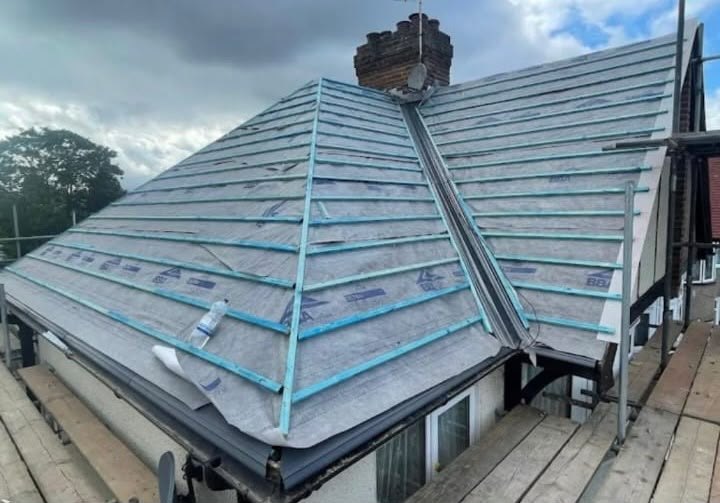
Same team from first visit to last, one person to ring, and no sub-contracting your work out to somebody you have never met. The quote is itemised, not a figure on the back of a card: access, stripping the old covering, any new deck or firrings, the insulation, the membrane and each upstand, outlet and edge trim, and disposal on separate lines, so you can compare it properly against anyone else's.
Nothing is left open or unusable overnight. The site is swept at the end of each day rather than the end of the job, and what comes out leaves with us. If something turns up once we start that nobody could have seen, you get a photograph and a price before we carry on.
The Isle of Wight Council is the planning authority here. A like for like re-cover is maintenance and needs no planning permission. Yarmouth carries a lot of listed entries for a town this small, and on a listed building consent covers work affecting the character of a listed building, including work out of sight from the street, so that is worth settling before anything is ordered. When most of a covering is renewed the roof counts as a controlled thermal element in Approved Document L, so the insulation reaches the current standard and building control is notified on a building notice.
Cost
What decides the price of a flat roof
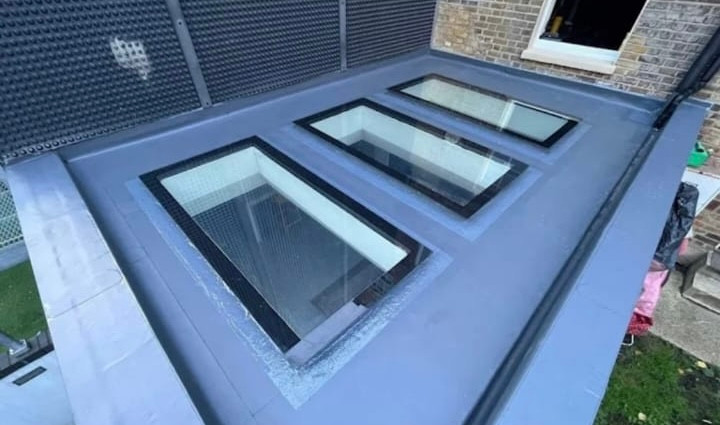
No rate per square metre, because the square metres are the easy part and what is under the covering is what decides the job.
Getting to it. A sun lounge across the back of a bungalow, a detached garage on a side drive and a small parapet roof in the old town are three different jobs before anything comes off. A garage or a single storey extension will often come off a tower, anything above a two storey wall wants a scaffold, and the platform has to stand while the deck is open rather than for an afternoon. The work at height rules are why it is a priced line rather than something folded into a rate.
The deck under the covering. A sound deck can be re-covered. Chipboard that has been wet for years, or ply that gives underfoot, has to come off and be replaced, and you cannot tell which you have from the ground or from a photograph. We lift a corner before quoting, because the deck is the single biggest swing in the price.
The falls, and where the water is meant to go. Most flat roofs that fail were never laid to a fall, or the fall runs at an outlet that has since been blocked or built over. Correcting it with firrings is more work than laying a membrane and it is the difference between a roof that lasts and one that ponds. Upstands, edge trims and each outlet are priced one at a time, because that is where the hours and the leaks both are.
Comparing quotes? Ask which system is being quoted and how many layers, whether the deck is being renewed or covered over, whether the falls are being corrected with firrings, how the upstands, outlets and edge trims are detailed, and whether the scaffold and the skip are in the price. Two quotes for the same job are usually two different jobs.
If it is coming through
Water through a flat roof
Ring rather than use the form. A flat roof that has split, blistered or lifted at an upstand puts water straight onto a ceiling, and once the deck is wet the damage carries on after the rain stops. The first visit is about getting it covered and dry, and we price the permanent job once we can see how much of the deck has gone. We are coming across from the mainland, so ring rather than use the form and we will be straight with you about when we can be there and what an emergency cover involves. The phone is answered 24 hours for emergencies; scheduled work runs Monday to Friday, 8am to 6pm.
Worth knowing
Salt gets at the fixings long before it gets at the covering
The water is close enough here to change the ironmongery rather than the membrane. EPDM, felt and fibreglass are all indifferent to salt. The screws, the trim fixings, the clamping ring on an outlet and the brackets holding a downpipe are not. Salt keeps a surface damp between showers and works into a fixing from the head down, and a trim held by a corroded screw lifts in the first proper blow. That is how most wind damage to a flat roof round here actually begins.
So on the seaward elevation we specify stainless wherever a fixing is exposed, keep the edge detail mechanically held rather than trusting adhesion on its own, and carry the upstand higher than the minimum where driven rain hits it. It is a small part of any quote and it is the part that decides whether the roof reaches its proper age. If another quote does not mention the fixings at all, it is worth asking what is going in.
Who you are dealing with
A local firm you can check
We cover Yarmouth, Norton, Thorley, Shalfleet and the PO41 side of the west Wight, and the site visit is free. You are dealing with Bournemouth Roofing & Building, the trading name of Bournemouth Roofing & Building Ltd, registered in England and Wales, company number 15471719, which you can look up in a minute. Thomas Hannen's business, and he is the one who comes out to price the job, not a salesman. A verified customer's 10 out of 10 on Checkatrade. The visit and the written quote are both free.
Questions
Yarmouth questions we get asked
Is the crossing a problem for a job this size?
No. The work is planned as consecutive days rather than dropping in and out, so the materials come across once and the roof is opened and closed in a single run. The visit to price it is free the same as anywhere else we go.
The flat over our bay is lead. Would you take it off?
Not if it is sound. Lead that has split at a roll or lost its drips can often be dressed and patched, and a lead flat that has been up a hundred years has earned the benefit of the doubt. Where it truly has gone we price relaying it alongside the alternative, and on a listed building the consent question gets settled first.
Does being this close to the water change the specification?
It changes the fixings and the edge details, not the covering. Stainless anywhere a fixing is exposed, a mechanically held trim on the seaward side, and an upstand carried higher than the minimum. The membrane itself is not troubled by salt.
My sun lounge runs with water every winter. Is the roof leaking?
Usually not. Where insulation sits between the joists with no air moving above it, warm air off the room reaches a cold board and turns to water on the underside. It drips like a leak and marks a ceiling like a leak, but no rain is involved. Building the roof warm, with the insulation over the boards, is what ends it.
Nearby, and next door
Flat roofing near Yarmouth
Flat roofing nearby
Our other trades in Yarmouth
Everything we do in Lymington Flat roofing, all areas Every area we cover
Free quote
Get a price for your Yarmouth flat roof
Tell us the address, what you have noticed and what the room below is used for. We will look and put an itemised price in writing.