Flat roofing in Norton
Back additions, lead flats, garage roofs and extension roofs around Norton and PO41. We look at the deck and the junctions, then price the job in writing.
The site visit is free and so is the written itemised quote. Thomas Hannen prices every job himself.
Flat roofs around Norton fall into two camps. There are old back additions that were once lead or zinc and have been patched in felt since, and there are modern garages and extensions. They fail for different reasons and they want different answers.
What brings the call is usually a ceiling. A brown ring that grows after a wet spell, a patch of plaster going soft near a wall, or a drip that only appears when the wind is in one particular direction. On an older building the water has often travelled a long way from where it got in.
So we look properly rather than guess. That means getting onto the roof, checking the junctions and the outlets as well as the covering, and opening a corner where there is a sensible place to open one. You get photographs, a straight view on repair against re-cover, and an itemised written price. Being this close to the water, the fixings and trims we specify are non ferrous, and that is written down too.
The work
Back additions, garage roofs and the old lead flats
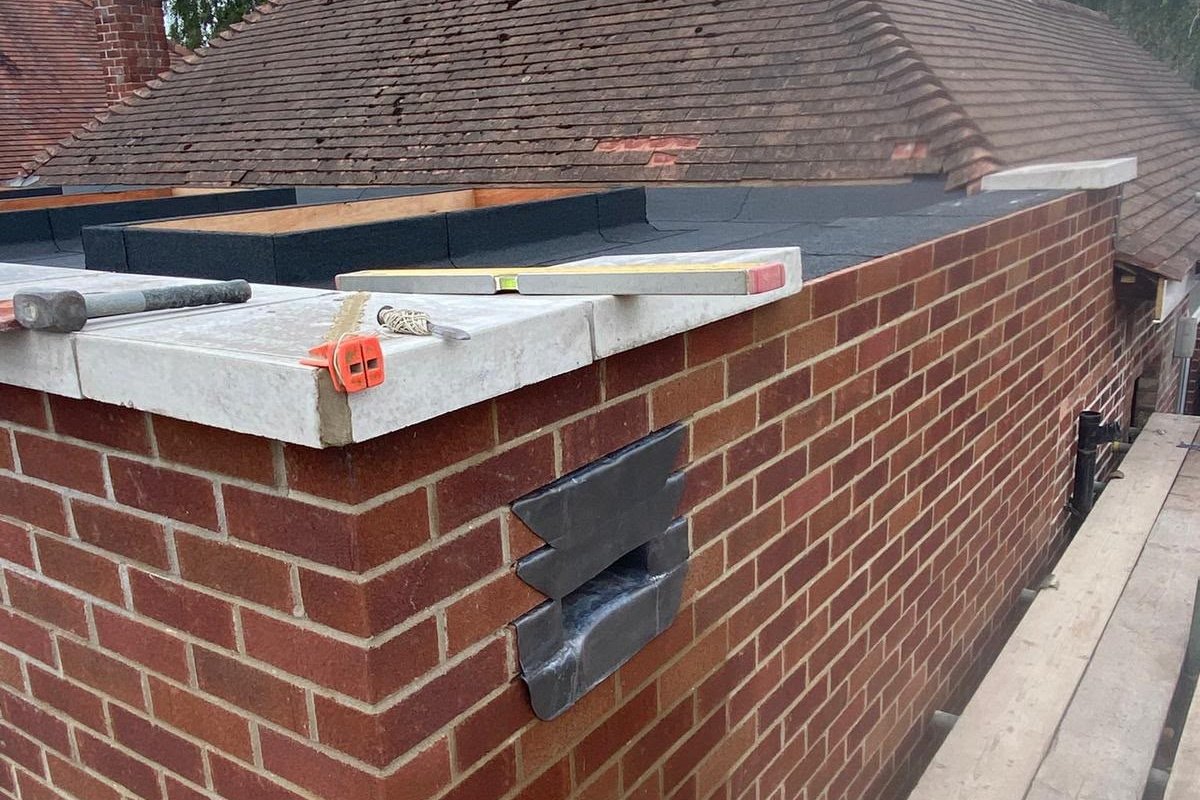
The old flats. A Victorian back addition or a bay top was originally lead or zinc, laid over boards with rolls and drips. Lead splits where it was fixed too tightly to move, and it fatigues along a drip. Zinc goes at the pinholes. Where the original metal is still there and the building suits it, relaying in lead is the honest answer. Where somebody has already covered it in felt, we take the lot off and start from the deck.
The modern ones. Felt again: a three layer built up system with a mineral cap sheet, or a single torch on layer laid over the last covering. It splits at the creases, blisters where damp was sealed in, and lifts at a seam against an upstand. We put back EPDM rubber on a plain rectangle, bonded in one sheet with no lap in the open field, GRP fibreglass where there are kerbs and corners to laminate round, or single ply hot air welded on a longer run.
Deck, joists and falls. Modern decking is plywood, OSB or chipboard, and wet chipboard gives underfoot and comes off. On an older building the joists are rarely level to start with, so the fall has to be built rather than assumed, and that is what the firrings do. A roof holding standing water in the same corner has ponding, not weather, and it is what finishes a covering early. BS 6229 sets out falls and drainage, and where re-firring will not work we form the fall in tapered insulation.
Insulation on an old building. Over a heated room, Part L brings the insulation up when the covering is renewed. We take it above the deck: a vapour control layer first, PIR over that, then the membrane, so the timber never sits in cold damp air. The old cold roof arrangement, with insulation packed between the joists, leaves the boards under the dew point, and interstitial condensation forms inside the construction where nobody ever looks. On a solid walled house the junction with the wall wants particular care, which is what BS 5250 is about. Building control are notified and inspect it open.
Junctions and openings. An abutment on a modern wall takes a chase, a lead cover flashing dressed into it and a cavity tray above. Old soft brick and stone are better served by a stepped flashing worked into the existing joints. Parapets get a coping with an apron under it. Openings all stand on a kerb so the covering can turn up an upstand, which means a rooflight, a lantern, a Velux style flat roof window, a hatch and a soil and vent pipe. The open edges finish over a drip trim, and the rainwater outlet feeds a hopper, a downpipe or the gutter. A garage is a day, a back addition two or three working days.
How it runs
From your call to a written price
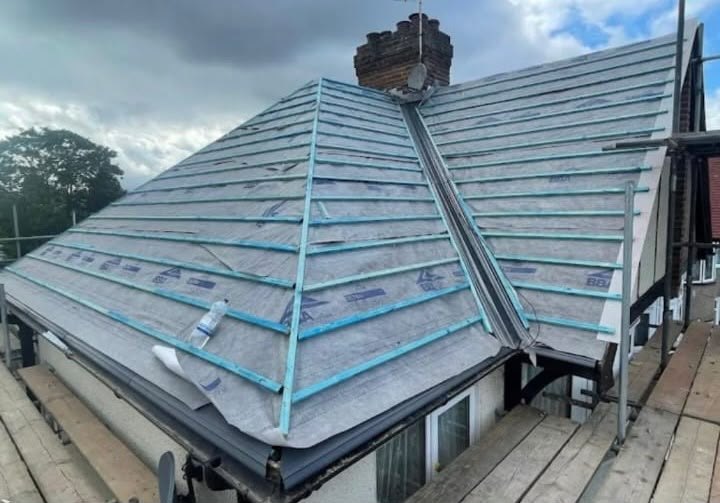
Same team from first visit to last, one person to ring, and no sub-contracting your work out to somebody you have never met. The quote is itemised, not a figure on the back of a card: access, stripping the old covering, any new deck or firrings, the insulation, the membrane and each upstand, outlet and edge trim, and disposal on separate lines, so you can compare it properly against anyone else's.
Nothing is left open or unusable overnight. The site is swept at the end of each day rather than the end of the job, and what comes out leaves with us. If something turns up once we start that nobody could have seen, you get a photograph and a price before we carry on.
Re-covering an existing flat roof is repair rather than development, so for most houses there is no planning permission to apply for and it stays inside permitted development. The Isle of Wight Council is the planning authority here, no conservation area covers this part of Norton, and the listed entries nearby are older buildings rather than the newer housing. Planning Portal guidance on roofs sets out where the line falls, and building control applies over any heated room.
Cost
What decides the price of a flat roof
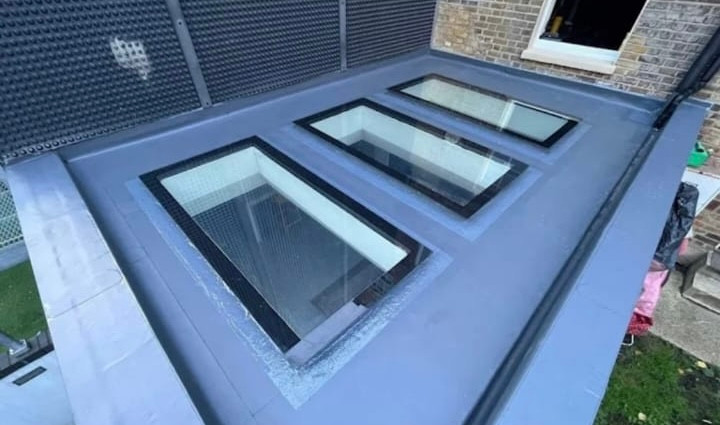
No rate per square metre, because the square metres are the easy part and what is under the covering is what decides the job.
Getting to it. A cottage with a lead flat over a back addition, a bungalow garage and a modern extension off a kitchen are three different jobs before anyone unloads. A garage or a single storey extension will often come off a tower, anything above a two storey wall wants a scaffold, and the platform has to stand while the deck is open rather than for an afternoon. The work at height rules are why it is a priced line rather than something folded into a rate.
The deck under the covering. A sound deck can be re-covered. Chipboard that has been wet for years, or ply that gives underfoot, has to come off and be replaced, and you cannot tell which you have from the ground or from a photograph. We lift a corner before quoting, because the deck is the single biggest swing in the price.
The falls, and where the water is meant to go. Most flat roofs that fail were never laid to a fall, or the fall runs at an outlet that has since been blocked or built over. Correcting it with firrings is more work than laying a membrane and it is the difference between a roof that lasts and one that ponds. Upstands, edge trims and each outlet are priced one at a time, because that is where the hours and the leaks both are.
Comparing quotes? Ask which system is being quoted and how many layers, whether the deck is being renewed or covered over, whether the falls are being corrected with firrings, how the upstands, outlets and edge trims are detailed, and whether the scaffold and the skip are in the price. Two quotes for the same job are usually two different jobs.
If it is coming through
Water through a flat roof
Ring rather than use the form. A flat roof that has split, blistered or lifted at an upstand puts water straight onto a ceiling, and once the deck is wet the damage carries on after the rain stops. The first visit is about getting it covered and dry, and we price the permanent job once we can see how much of the deck has gone. Norton is across the water from us, so we build the crossing into the day and give you a firm time rather than a window when it is an emergency. The phone is answered 24 hours for emergencies; scheduled work runs Monday to Friday, 8am to 6pm.
Worth knowing
A quarter of the houses here are older than the materials we normally use
Norton has a lot of pre-1900 fabric, more than anywhere else we work. Those houses have solid walls that have to be able to dry out, lime rather than cement in the joints, and a back addition with a flat roof that was never designed around a plastic membrane. None of that stops you having a modern covering. It changes two details, and they are the two that get skipped.
The first is the abutment. Hacking a deep chase into soft old brick to take a cover flashing does more harm than good, so on the right wall we step the flashing into the existing joints instead and point it in lime. Cement over an old wall cracks within a few winters and then it leaks worse than before. The second is moisture. A warm roof laid tight against a solid wall can trap damp at the junction if the vapour control layer is taken to the wrong place, so we detail that properly and say on the quote how it is being done. Ask any other quote the same question.
Who you are dealing with
A local firm you can check
We cover Norton, Yarmouth, Freshwater, Totland and the rest of PO41. You are dealing with Bournemouth Roofing & Building, the trading name of Bournemouth Roofing & Building Ltd, registered in England and Wales, company number 15471719, which you can look up in a minute. Thomas Hannen's business, and he is the one who comes out to price the job, not a salesman. A verified customer's 10 out of 10 on Checkatrade. The visit and the written quote are both free.
Questions
Norton questions we get asked
Should an old lead flat be relaid in lead or covered in rubber?
It depends what it is on and who can see it. Lead relaid properly, with the right size bays and room to move, lasts longer than anything else we fit. On a hidden roof where cost matters more, EPDM is a sensible answer. We will price both and explain the difference.
Why does my ceiling only stain when the wind blows from one side?
Because the water is being driven in at a junction rather than falling through a hole. Wind pushes rain up under a lap, behind a flashing or over a short upstand. That is why we look at the detailing before condemning a covering.
Do you charge extra for coming over to the Island?
The site visit and the written quote are free wherever you are. What we do is plan the work so the crossings are used properly, which usually means fewer, longer days on site rather than part days.
Can you work in winter?
Yes. EPDM is bonded cold and does not mind the temperature the way a resin does. We watch the forecast, and we will not strip a deck we cannot get closed and watertight again before the light goes.
Nearby, and next door
Flat roofing near Norton
Flat roofing nearby
Our other trades in Norton
Everything we do in Lymington Flat roofing, all areas Every area we cover
Free quote
Get a price for your Norton flat roof
Tell us the address and what you have noticed. We will come out, look under the covering where we can, and put an itemised price in writing. No charge, and no obligation.