Reclaimed or new brick: which to use for a repair
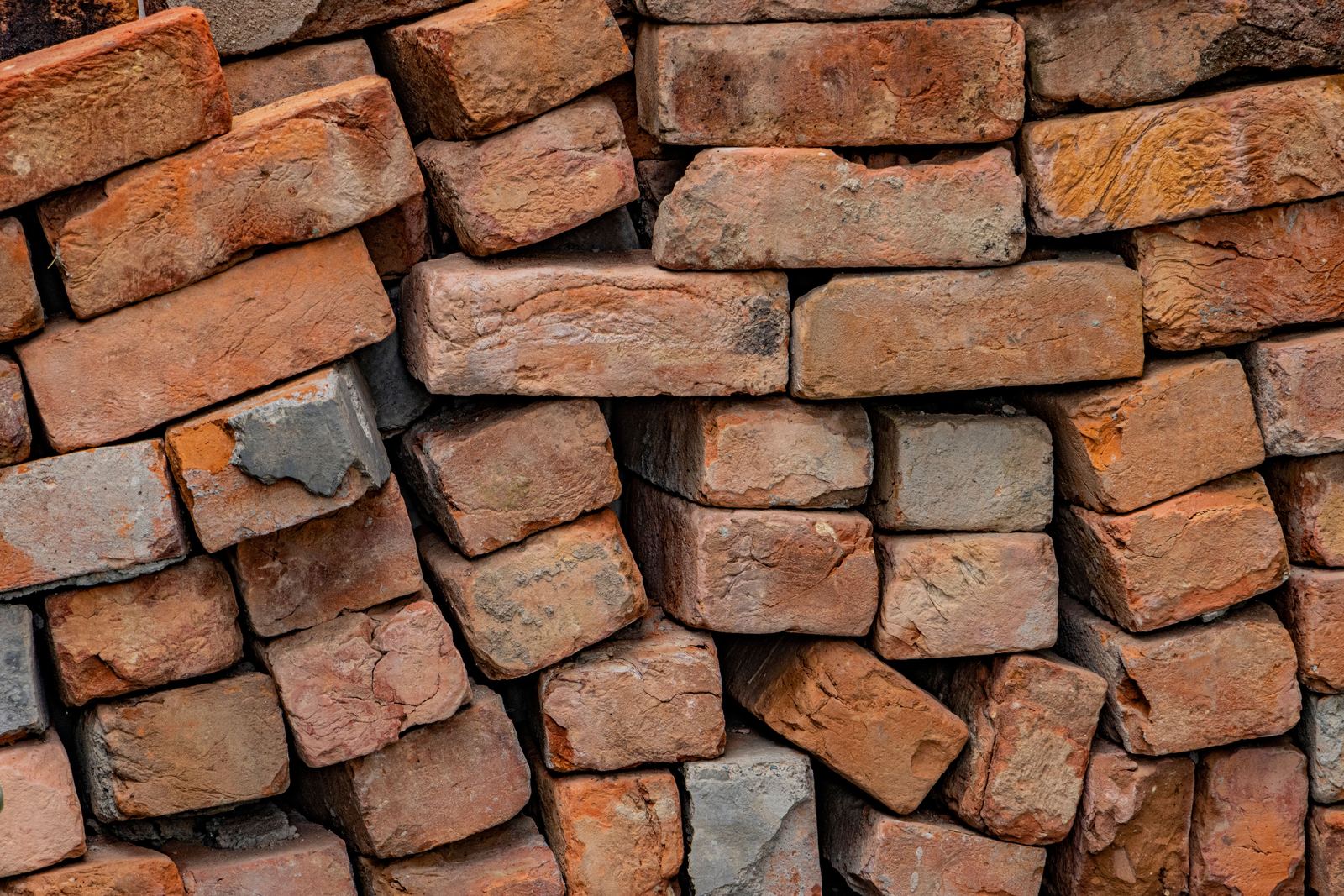
Age is not evidence of durability, and the pallet in the yard is half the bricks that never faced the weather.
Neither is automatically right. A new clay brick comes with a declared frost resistance, salt content and size. A reclaimed one comes with none of those, because the standard covers new bricks only. Buy reclaimed when the yard can tell you which external wall they came off, and not otherwise.
The short version
- Age is not evidence. A demolition pallet mixes the internal bricks out of a party wall with the external ones off the front elevation, and they look much the same once the mortar is off.
- Salmon-pink bricks that give a dull thud rather than a ring when you tap two together were internal bricks. Put them in an outside wall and you will be rebuilding it.
- Imperial bricks are taller than metric ones, so the coursing will not line through with existing work unless somebody has worked out the gauge before laying a single brick.
- Matching the brick and then not matching the mortar is the commonest cosmetic failure on a repair. The joints are about a sixth of what you see from the pavement.
Who is telling you this
Everybody in this argument is selling one of them
Search this question and you get two kinds of page. Reclamation yards, who sell reclaimed brick. And the Brick Development Association, which speaks for almost all new brick production in this country. Neither declares the interest. We lay both and we sell neither, which is the only reason this page is worth reading.
So here is how we are using the BDA. Its guide to the reuse of clay brickwork is the most detailed public document on the subject, and its facts hold up because they are corroborated by the scope of the standard itself. Its conclusion leans towards new brick, which is what you would expect, and we have not adopted that wholesale. Reclaimed brick is the right answer on plenty of jobs. It is just not the right answer for the reason most people buy it.
The letters
What a new brick declares, and where each grade belongs
A new clay brick is sold with two performance letters against it. BS EN 771-1, the specification for clay masonry units, grades freeze and thaw resistance as F2 for severe exposure, F1 for moderate, and F0 for a brick that is not frost resistant and belongs indoors or behind impermeable cladding.
It grades active soluble salts separately: S2 is the lowest salt content and suits masonry that stays saturated, S1 is normal exposure, S0 sets no limit at all. They are specified together, so a brick for a hard position reads F2S2.
The reason those letters matter is that they map onto positions on a house. F2 belongs below the damp proof course, in plinths, in chimneys, under copings and cappings, and in sills. Those places soak from two or three faces at once and cannot dry off one, and that is where a wrong brick fails first. A free-standing garden wall is the most exposed brickwork on most sites for the same reason, which is worth knowing before you build one to the height the rules allow. If you want the mechanism rather than the grades, we set out why frost damage to brickwork shows up after the thaw separately.
The reframe
An old brick has not proved anything
The argument for reclaimed usually goes: it stood through a hundred winters, so it must be durable. The BDA answers that in one sentence, and it should reframe the whole decision. To assume that because a brick is old it must have proven frost resistance is incorrect.
Think about where reclaimed bricks come from. A demolition contractor takes down a house. The front elevation faced the weather for a century, the party wall and the internal partitions never saw rain, and all of them go onto the same pallet. The internal ones were often underfired and softer, because they were never meant to get wet. Only bricks known to have come from an exposed external situation should be treated as frost resistant, and that is a question about paperwork, not about looks.
The reason nobody can hand you a grade is structural to the standard. Frost resistance, soluble salts, strength, water absorption and size are all declarations covered by BS EN 771-1, and it covers new clay bricks only, because every relevant test draws its samples from a newly manufactured consignment. You can send a sample of reclaimed bricks for a freeze and thaw test, but as the BDA puts it, the result cannot be extended to classify the whole consignment because consistency cannot be fully known. Twenty bricks passing tells you about twenty bricks.
Salts are worse, because there is no way of knowing the salt content of reclaimed brick at all. The BDA's advice is to treat reclaimed as Category S1, and that is a floor rather than a measurement. If the wall stays wet, that assumption is doing a lot of work. It matters most at the bottom of a wall, where Approved Document C puts the damp proof course 150mm clear of the ground, and that is the subject of damp at the bottom of a wall.
The practical bit
The sizes are what actually catches people out
Brick size is the part that turns a good-looking pallet into a bad-looking wall. British bricks changed size twice, and an old house is very likely coursed to a gauge your bricklayer does not use.
The metric standard brick, adopted in 1974, is 215 x 102.5 x 65mm. The imperial standard, set in 1965, is 219 x 104.8 x 66.8mm. Before that the country ran on regional habit. A southern brick was 2 5/8 inches tall, and with a 3/8 inch bed joint that puts four courses in exactly 12 inches, 305mm. A northern brick was 2 7/8 inches, four courses to 13 inches, 330mm. Imperial-compatible heights are still manufactured, in 80mm, 73mm, 67mm and 50mm.
Now the arithmetic that catches everybody. Metric brickwork courses at 75mm, a 65mm brick and a 10mm bed, so four courses come to 300mm. Set imperial bricks to that same 300mm gauge and each bed joint drops to about 8mm, because the bricks are taller. Lay them at 305mm to match the old wall and your gauge no longer agrees with anything else on site. Either way the coursing will not line through with the existing work, and a repair that is out by five millimetres every four courses is visible from the far side of the road.
One more warning from the same guide, and it is a good one. Up to as late as 1965 many bricks conformed to no standard at all. So whether you are buying new imperial or reclaimed, the detailed dimensions have to be checked against the actual brick in front of you and against the actual wall you are matching. Not against a size printed in a catalogue.
The other assumption
A new brick that matches almost always exists
The strongest argument for reclaimed is the one nobody checks: that only an old brick can match an old house. There are currently over 4,000 types of brick made in the UK from many different clays, handmade and simulated handmade production both continue, and a suitable match is usually findable within those ranges.
The line that settles it: when Hampton Court and Kew Palace have bricks replaced, new bricks are specified, made to the sizes and special shapes required. If new brick is right for those two buildings it is not automatically wrong for a Victorian terrace. The exception is where planning consent or a listed building consent for repointing and rendering specifically requires reclaimed material, which does happen in conservation areas. Then the decision is made for you, and the job is to buy carefully.
| Dimension | Reclaimed brick | New brick |
|---|---|---|
| Covered by BS EN 771-1 | No. Every test draws samples from a newly manufactured consignment | Yes. Frost, salts, strength, absorption and size all declared |
| Frost resistance | Unknown unless the supplier can assure they came only from external walling | Declared as F0, F1 or F2 |
| Soluble salts | Unknown. Treat as S1 and design around it | Declared as S0, S1 or S2 |
| Compressive strength | Not established. Testing is destructive and impractical on a mixed batch | Declared |
| Size consistency | Variable, and imperial coursing does not line through with metric | Consistent, and imperial-compatible heights are made |
| Colour and texture | Already weathered. This is the reason people buy them | Over 4,000 UK types. Handmade ranges still produced |
| Cleaning off old mortar | Hand work with hammer and bolster. Power tools are not advised and acid is not recommended for the first removal | None needed |
| Use as paving | Great caution advised for walling bricks laid flat | Clay pavers are specified as fully frost resistant |
| Professional indemnity | Not covered by a British Standard, so a specifier should check their own cover | A standard product with a declaration of performance |
| Relative cost and supply | Often dearer than new, and availability is patchy | Usually the more cost-effective route, and orderable |
The verdict
So which should go into your wall?
Reclaimed brick is right when the supplier can say which building and which part the bricks came from, and new brick is right for structural and exposed positions. Neither is right for reclaimed bricks with no history, or reclaimed walling bricks laid as paving.
Reclaimed is right when
The supplier can tell you which building and which part of it the bricks came from, you know that part was an external wall, and the match matters more to you than the certainty. Also when consent conditions require it. On a sheltered elevation, above the damp proof course, with a known provenance, reclaimed brick does a job new brick cannot.
New is right when
The work is structural, below the damp proof course, on a chimney, a parapet, a coping, a sill or a free-standing garden wall, or anywhere the masonry soaks from more than one face. Those positions want a declared F2, and only a new brick has one. New is also right far more often than people assume, because a specialist match usually exists.
Neither: reclaimed off a pallet with no history
If the yard cannot say which part of which building the bricks came from, walk away. That is not a technicality, it is the whole basis of the decision, and you can test it yourself standing in the yard. Pick up two and knock them together. A well-fired external brick rings. A salmon-pink brick that answers with a dull thud is soft and underfired, and it was an internal brick. Putting those in an outside wall means rebuilding it.
Neither: reclaimed walling bricks as a patio or a path
Laid flat, a brick holds water instead of shedding it, so paving is a harder duty than walling. Clay pavers have to be fully frost resistant. Reclaimed pavers that were previously laid fully exposed to the weather can be used with confidence, and the BDA says so. Reclaimed walling bricks used as paving is where it advises great caution, and we would go further and say do not. Different exposure, different requirement. If you are choosing a surface, that belongs with the rest of the driveway and patio decision.
The one that catches everybody. Match the brick and forget the mortar and the repair still reads as a patch from the pavement. Work it out on standard coursing and the joints are roughly 17% of the wall face, so the mortar is a sixth of what anyone is looking at. Colour, sand, and the joint profile all have to match, and on an old wall so does the binder: see lime mortar against cement mortar for repointing. Get the specification written down, which is what reading a repointing quote covers.
Next steps
What to do next
Before buying brick, work out what position it is going into, measure four courses and a stretcher, photograph the wall in daylight, and ask a merchant to match it in new brick. The first four cost nothing.
- Work out what position the brick is going into. Below the damp proof course, a chimney, a coping or a garden wall settles it before anything else.
- Take a tape to the wall. Measure four courses top to top, and measure a stretcher. Those two numbers tell a supplier whether you are on metric, imperial or something older.
- Photograph the wall in daylight, with a brick held against it. Colour reads differently wet, dry and in shade.
- Take the photograph and the measurements to a merchant with a wide range and ask them to match it in new brick first. If they can, the decision is easier and the wall is stronger.
- If you go reclaimed, ask the yard one question in writing: which building did these come from, and which part of it. Anything vaguer than an answer to that is a no.
- Agree the mortar at the same time as the brick. Mix, sand, colour and joint profile, with a sample panel left up for a week before the main run.
If you would rather somebody looked at the actual wall, that is what our bricklaying and repointing work covers, and a free written itemised quote comes out of it. Thomas Hannen prices the job himself. If he thinks the pallet you have been offered is half internal brick, he will say so before anybody starts laying.
Questions
Common questions
Are reclaimed bricks frost resistant?
Not knowably, BS EN 771-1 declares frost resistance for new clay bricks only, because the tests draw samples from a newly manufactured consignment. A reclaimed brick carries no declaration, and the Brick Development Association is clear that assuming an old brick has proven frost resistance is incorrect. Only bricks known to have come from an exposed external wall should be treated as frost resistant.
How can I tell an internal brick from an external one in a reclamation yard?
Tap two together: a well-fired external brick rings. A dull thud usually means a softer underfired brick, and salmon-pink colouring points the same way. Those were internal bricks and they were never meant to get wet. It is a rough test, not a laboratory one, but it will stop you buying a pallet you would have to take back out of the wall.
Can I use reclaimed bricks for an extension?
Above the damp proof course, on a sheltered elevation, with known provenance from external walling, yes. Below the damp proof course, on a chimney, a parapet, a coping or a free-standing wall, use new brick with a declared F2 frost resistance. Building control and any structural design will also want a declared compressive strength, which reclaimed brick does not have.
Will reclaimed imperial bricks match my old coursing?
Not automatically, an imperial brick is 66.8mm tall against a metric 65mm, so four courses set to the metric 300mm gauge leave bed joints of about 8mm. Many bricks laid before 1965 met no standard at all, so measure four courses and a stretcher on your own wall and give the supplier those numbers rather than a size from a catalogue.
Can reclaimed bricks be used for a patio?
Reclaimed clay pavers that were previously laid fully exposed to the weather can be, with confidence. Reclaimed walling bricks laid as paving is a different matter and the Brick Development Association advises great caution. Laid flat a brick holds water instead of shedding it, so it faces a harder duty than it did in a wall.
Read next
Related advice
The guides below pick up where this one leaves off, and the bricklaying and repointing page covers the work itself and the places we cover, if you would rather have the job looked at.
- Lime or cement mortar: which your wall actually needs
- Frost damage to brickwork and paving
- Reading a repointing quote: what rake out should mean
- Garden wall planning permission and height rules
Bricklaying and repointing, and where we cover All advice articles
Who wrote this
Thomas Hannen
Thomas owns Bournemouth Roofing & Building and prices every job himself instead of sending somebody else. The company is Bournemouth Roofing & Building Ltd, number 15471719, registered in England and Wales. If you want to talk something through before you commit to anything, the site visit and the written itemised quote are both free.

Free quote
Not sure the bricks you have been offered belong in that wall?
Thomas comes out, looks at the wall, measures the coursing and says plainly whether the match should be new or reclaimed and what mortar goes with it.