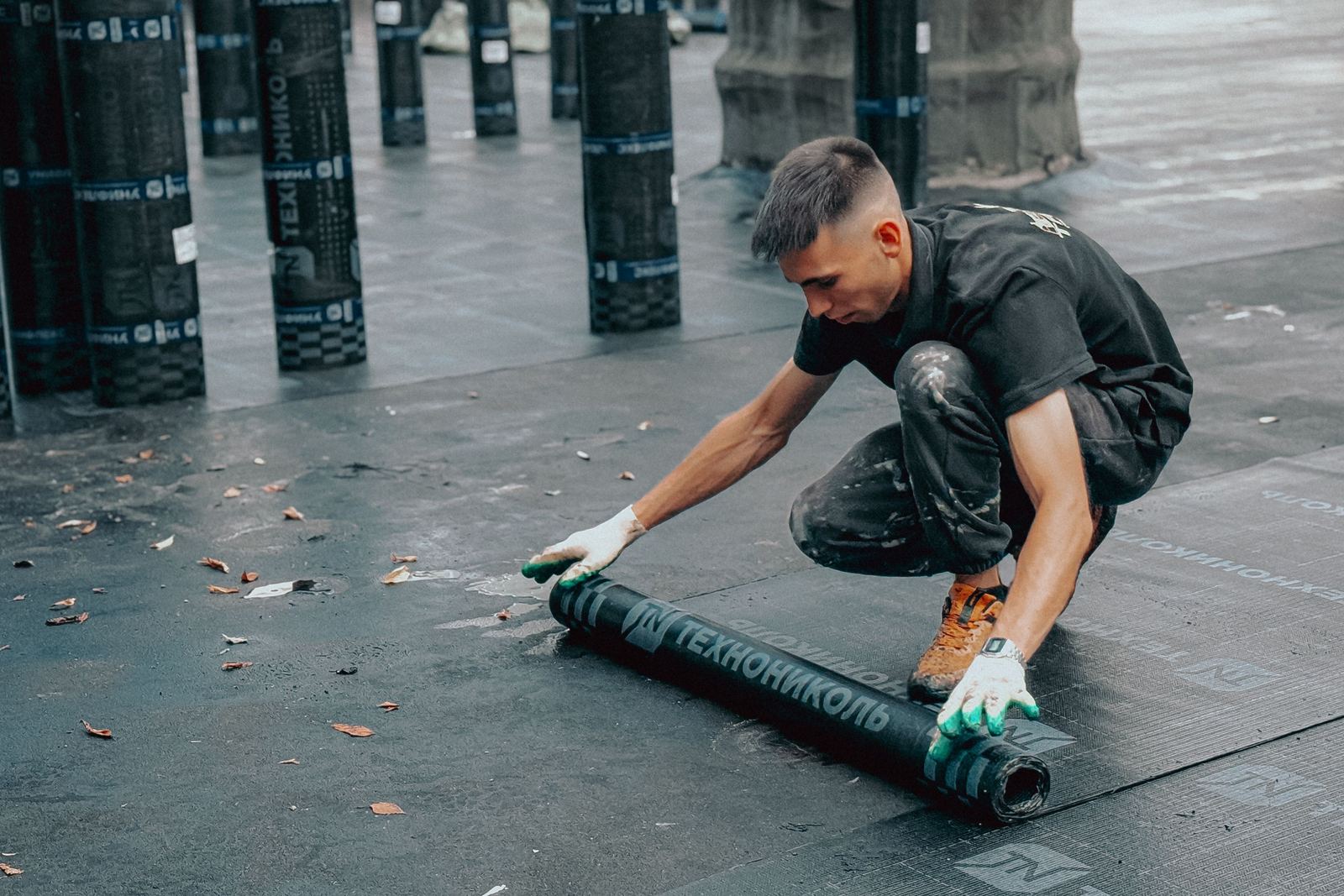
Flat roof repair: when to patch, when to overlay and when to replace
The covering shows you where the water gets in. The deck underneath decides what the repair should be.
Patch a flat roof when the damage is local and the deck is dry and firm. Overlay only when the old covering is well bonded and the deck is dry. Replace when the deck is soft or wet. Under Approved Document L, replacing the membrane on over half the roof means upgrading the whole roof to U-value 0.16 where feasible.
The short version
- The covering tells you where the water gets in. The deck underneath decides the repair. A soft or springy patch of deck rules out patching and overlaying in that area.
- An overlay laid on a wet deck seals the water in. Both BBA certificates quoted below require a dry deck before their system goes down.
- Repair a covering with its own material. The GRP certificate’s only repair is cut out, grind back 100 mm and re-laminate, and the EPDM certificate says to keep bitumen products off the membrane. A felt patch belongs on felt.
- If the outlets are clear and water still stands two days after rain, the fall is wrong. A patch or an overlay on the same fall will not cure it.
- A patch is not a Part L job. Replacing the membrane across more than half the roof is, and the whole roof then has to reach a U-value of 0.16 where that is feasible.
Reading the roof
Four signs, and what each one says about the repair
Most flat roof faults show up as one of four things, and each points to a different repair.
Blisters
A blister is a dome where the covering has lifted off the layer beneath it, usually because air or moisture got trapped when it was laid and expands in the sun. A blister that is firm, uncracked and not growing is not a leak. Leave it alone, because cutting into it makes a hole where there was not one. If a blister has split, patch it like any other split. If blisters cover a large part of the roof, the layers have stopped bonding and the covering is near the end of its life.
Splits and cracks
A single split in felt that still bends without cracking is a patch. Crazing across the whole surface, or felt that snaps when you lift an edge, means it has dried out and a patch will just move the leak a few inches along. On GRP, a crack running in a straight line usually follows a board joint underneath, which means the deck is moving. The laminate can be repaired, but if the deck keeps moving the crack will come back.
Ponding
Standing water is not a covering fault. BS 6229, the code of practice for flat roofs was revised on 16 December 2025, and the BBA certificate for the GRP system quoted below sets a minimum finished fall of 1:80, which is 12.5 mm of drop per metre. If the outlets are clear and the roof still holds water two days after rain, it does not have that fall, and a patch or an overlay laid on the same fall leaves the water where it is. The fix is firring the falls up or laying tapered insulation, and that turns the job into a replacement. The detail is in our comparison of GRP, EPDM and felt, which uses the same standard.
A soft deck
If the roof gives underfoot, or a ceiling below has a wide stain rather than a drip mark, the boards have been wet for a while. Whatever covering is on top, that section of deck has to come out. If you are not sure whether the stain is a leak at all, condensation and a roof leak can look very alike from underneath.
| What you see | Patch | Overlay | Strip and replace |
|---|---|---|---|
| One split or puncture, firm dry deck | Yes | Not needed | Not needed |
| Firm, uncracked blisters | Leave alone | Not needed | Not needed |
| Felt crazed or brittle all over, deck dry and firm | Will not last | Possible, if the old felt is well stuck down | Yes, if the old felt is loose |
| Water standing two days after rain, outlets clear | Does not fix it | Does not fix it | Yes, with the fall corrected |
| Soft or springy deck, or a wide ceiling stain | No | No | Yes, at least the wet section of deck |
| Repeated cracks along GRP board joints | Short term only | No, the deck movement carries through | Yes, if the deck is the cause |
Overlays
Why an overlay on a wet deck makes things worse
An overlay is a new waterproof layer laid over the old covering instead of stripping it. On the right roof it is a good repair. On the wrong one it seals the water in.
The manufacturers’ own certificates assume a dry base. BBA Agrément Certificate 93/2932, for a GRP system, says the board “should be dry, sound, and free from loose material or contamination”. BBA Agrément Certificate 89/2216, for an EPDM system, says “deck surfaces must be dry”. Neither one describes going over a deck that has been taking in water.
Water already in the deck cannot dry out upwards through a new waterproof layer. The timber stays wet and rots faster, and trapped moisture lifts the new covering into blisters. The roof stops dripping for a season while the deck gets worse out of sight.
So before agreeing to an overlay, ask how the person quoting knows the deck is dry. Good answers include lifting the covering at an edge or around an outlet to look, opening up the ceiling below where the stain is, or checking with a moisture meter at several points. A bad answer is “it’s fine” from someone who has not been up there.
Two other conditions make an overlay the wrong choice even on a dry deck. The old covering has to be stuck down well enough to carry a new layer, because a loose sheet underneath will move and take the new one with it. And the extra thickness has to fit at door thresholds, under flashings and at the outlets. If insulation is part of the overlay, the roof changes from cold to warm, or to a hybrid of the two, and that has its own condensation rules, set out in warm roof against cold roof.
Paint-on and liquid coatings sold for DIY repair are an overlay too. Over a wet deck they trap the water in exactly the same way.
Matching the material
Repair felt with felt, EPDM with EPDM and GRP with GRP
Each covering has its own repair method. The wrong material on top often holds for a few months, which is why it keeps being done.
GRP. The certificate for one GRP system gives exactly one repair method. The damaged section is cut out, the surrounding area is ground to “a roughened, feathered surface extending 100 mm in each direction”, and the repair is made with the system’s own glass mat and base resin, followed by a colour-matched topcoat. A felt patch, a tub of bitumen mastic or a strip of tape is not that repair. Anything stuck to the laminate has to be ground off before the proper repair can bond, so a quick patch also makes the eventual repair bigger.
EPDM. Repairs are easy if you use the right material: clean the area and apply an EPDM patch or a self-adhesive EPDM flashing, as the certificate describes. What must not happen is bitumen. The same certificate says contact with bituminous, coal tar and oil-based products must be avoided because the membrane is not compatible with lower grades of bitumen. So no felt patches, no bitumen mastic and no black paint-on sealant from the shed on a rubber roof. It also means EPDM cannot simply be laid onto old felt. An isolating layer has to go between them, so ask whether it is in the quote.
Felt. Reinforced bitumen membranes take bitumen-based patches and a new felt layer bonded over the old, which is why felt is the easiest covering to overlay. The weak point is the edge of the patch on aged felt. If the felt around a split is brittle, the patch stays put and the felt next to it cracks.
| Existing covering | Right repair | Wrong repair |
|---|---|---|
| GRP fibreglass | Cut out, grind back 100 mm, re-laminate with the system’s glass mat and resin, then topcoat | Felt patch, bitumen mastic, tape |
| EPDM rubber | Clean, then an EPDM patch or self-adhesive EPDM flashing | Anything bitumen based, including felt and mastic |
| Felt (reinforced bitumen) | Bitumen-based patch or a bonded felt layer, provided the surrounding felt is still flexible | A patch on felt that cracks when lifted |
To tell what you have, look at an edge or upstand. Felt has a mineral or sand finish over black bitumen, GRP is hard and smooth like a boat hull, and EPDM is soft rubber that stretches under your thumb. Each certificate covers one named system, so ask which system your roof is.
Building regulations
When a flat roof repair becomes a Part L job
A patch is a repair and the energy rules do not apply. Replacing the covering across most of the roof is a renovation, and then they do.
The rule is in regulation 23 of the Building Regulations 2010. Where the renovation of a thermal element amounts to more than 50% of its surface area, or is a major renovation, the whole element has to be brought up to standard, in so far as that is technically, functionally and economically feasible. Approved Document L Volume 1 then defines renovation in paragraph 11.2, and item (d) on its list is “replacing the waterproof membrane on a flat roof”. Paragraph 11.3 says that where more than 50% of the surface of the individual thermal element is renovated, or the work is a major renovation, the whole element should be improved to achieve at least the U-value in Table 4.3, column (b), which for a roof is 0.16 W/(m²·K).
On a flat roof:
- Patching a split or a puncture is nowhere near half the roof. No upgrade is triggered.
- Replacing the covering on most of the roof, which is how a garage or extension roof is normally done, crosses the 50% line. The whole roof should then be insulated to 0.16, where that is feasible.
- An overlay is not named on the list as a separate item. Whether a new membrane laid over the old one counts as replacing the membrane is a question for building control, so ask them before work starts rather than after.
There are two ways out, and both are in the guidance. Paragraph 4.13 lets the roof reach the best U-value that is feasible and pays back within 15 years, where 0.16 does not, and generally no worse than 0.7 W/(m²·K). Note 4 to Table 4.3 says a lesser standard may be appropriate on a flat roof where the load-bearing capacity of the frame or the height of the upstand is a problem. That matters, because added insulation raises the roof at door thresholds and flashings.
The government’s Approved Document L page also lists a 2026 edition. Its own text says it takes effect on 24 March 2027, and it keeps the same flat roof item and the same 0.16 for a renovated roof. More depth is in what Part L requires when you re-roof, and the build-up that reaches 0.16 is part of our insulation work.
Safety
Before anyone stands on it
A flat roof with a soft deck is a fragile surface, and that includes yours. HSE’s guidance on fragile surfaces says all roofs should be treated as fragile until a competent person has confirmed they are not, and its list of likely fragile materials names “chipboard, or similar material where rotted”. If a garage roof is corrugated fibre cement sheet, that is on the list too.
Before you go up. Do not walk on a flat roof that gives, sags or sits over a stained ceiling. Check it from a window above, from a ladder at the edge without stepping onto it, or from underneath. On a building built or refurbished before 2000, HSE’s diagram of where asbestos is found in a house includes roofing felt, so do not cut, grind or sand old felt until it has been checked.
You can safely clear outlets you can reach from a ladder that is level, stable and footed, check for standing water from a window, and pencil round the ceiling stain to see if it grows. If water is coming in now, the steps in emergency tarpaulin and temporary repairs are safer than climbing out with a tub of sealant, and the ceiling stain guide helps you trace where the leak is coming from.
Next steps
What to do next
Four things decide between patch, overlay and replace: the covering, whether the deck is dry and firm, whether water stands, and how much of the roof the work covers.
- Identify the covering from an edge or upstand: felt, GRP or EPDM.
- With the outlets clear, check for standing water two days after heavy rain, from a window or the ground.
- Look underneath. A small drip mark points to a local fault. A wide stain or sagging ceiling points to a wet deck.
- If a quote proposes an overlay, ask how the deck was confirmed as dry, and, for EPDM over felt, whether an isolating layer is included.
- If a quote proposes a patch on GRP, ask whether it is a laminate repair with the system’s resin or something stuck on top.
- If the covering is being replaced across most of the roof, ask how the quote deals with Part L, and compare it against what a roofing quote should include.
A single split on a firm, dry roof does not need a new roof, and anyone who says otherwise should explain why. If you want it looked at, our flat roofing and roof repair work sits under our wider roofing services. Thomas Hannen comes out to price the job himself, looks at the covering and the deck, and you get a free written itemised quote that says whether it is a patch, an overlay or a replacement, and why.
Questions
Common questions
Can a leaking flat roof be patched, or does it need replacing?
It can be patched when the damage is in one place, the covering around it is still sound and the deck underneath is dry and firm. If the deck is soft, the ceiling stain is wide, or water stands on the roof two days after rain with the outlets clear, a patch will not cure it and that part of the roof needs replacing.
Can you put a new flat roof over the old one?
Sometimes. An overlay works when the old covering is well bonded and the deck is dry. Over a wet deck it seals the water in, and both the GRP and EPDM certificates quoted here require a dry deck. EPDM laid over old felt also needs an isolating layer, because the membrane is not compatible with lower grades of bitumen.
Can I repair a fibreglass flat roof with felt or bitumen?
Not properly. The GRP certificate's repair is to cut out the damage, grind the surrounding area back 100 mm in each direction and re-laminate with the system's own glass mat and resin. A felt patch or mastic has to be ground off before that repair can bond.
Does replacing a flat roof need building regulations?
Replacing the waterproof membrane on a flat roof counts as renovation under Approved Document L. If more than 50% of the roof is renovated, the whole roof should be insulated to a U-value of 0.16 where that is technically, functionally and economically feasible. A patch repair does not trigger this. Ask the roofer how the work will be signed off with building control before it starts.
Is it safe to walk on my flat roof to check it?
Not if it gives, sags or sits over a stained ceiling. HSE says all roofs should be treated as fragile until a competent person confirms otherwise, and it lists rotted chipboard as a likely fragile material. Check from a window, from a ladder at the edge or from underneath.
Read next
Related advice
The guides below pick up where this one leaves off, and the roofing page covers the work itself and the places we cover, if you would rather have the job looked at.
Who wrote this
Thomas Hannen
Thomas owns Bournemouth Roofing & Building and prices every job himself instead of sending somebody else. The company is Bournemouth Roofing & Building Ltd, number 15471719, registered in England and Wales. If you want to talk something through before you commit to anything, the site visit and the written itemised quote are both free.
Free quote
Not sure whether it needs a patch or a new roof?
Thomas comes out, checks the covering and the deck, and puts what he found in a written, itemised quote, including when a patch is all the roof needs.